
No products in the cart.
Blog
Where Are Psychedelic Mushrooms Legal in the US?
15
Feb
Feb
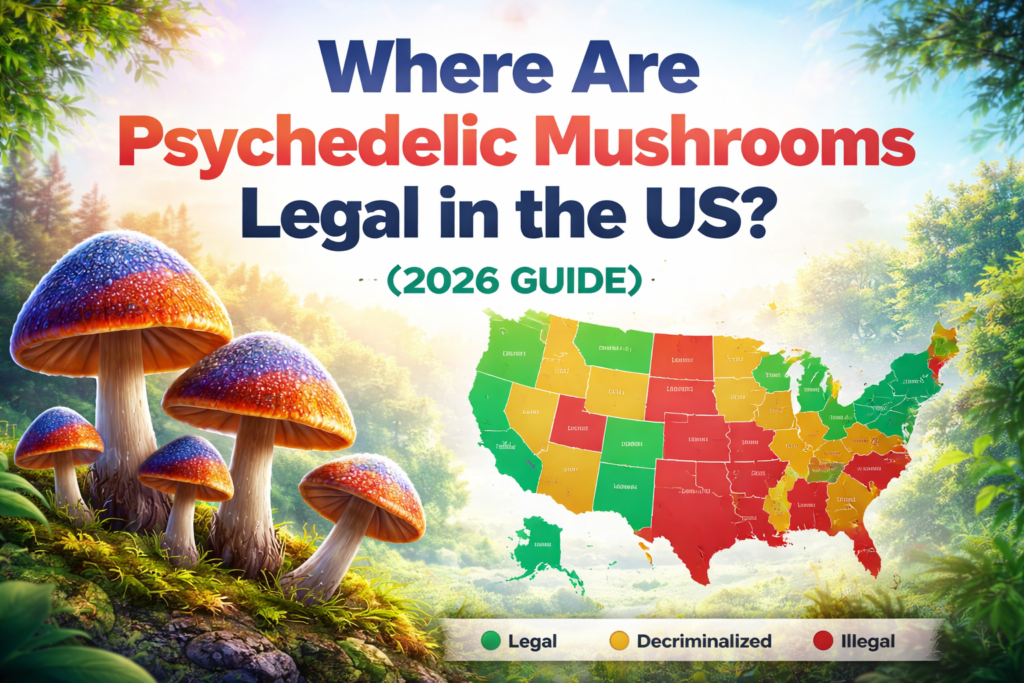
Psilocybin mushrooms are still illegal under federal law in the United States. However, limited legal access exists in Oregon, Colorado has decriminalized possession and is building a regulated system, and several cities have reduced enforcement priorities.
👉 If you’re trying to understand what’s actually allowed in your area, the breakdown below makes it simple.
Federal Law Status (Why It’s Still Restricted)
Is psilocybin legal in the US federally?
No. Psilocybin is classified as a Schedule I controlled substance.
In practical terms, this means:
- It is treated as having no accepted medical use federally
- Possession, sale, and distribution are prohibited nationwide
- Research is tightly controlled and regulated
Even if a state changes its laws, federal restrictions still apply.
States With Legal or Regulated Psychedelic Access
Oregon Psilocybin Services (First Legal Framework)
Oregon is currently the most advanced example of regulated psilocybin access in the US.
Here’s how it works:
- Adults 21+ can participate in supervised sessions
- Licensed facilitators guide the experience from start to finish
- Sessions take place in approved service centers
- The focus is therapeutic—not recreational
💡 In simple terms, Oregon allows psilocybin use only in structured, professional settings.
Learn how Oregon’s psilocybin therapy system works and what a legal session actually looks like.
Colorado Psilocybin Reform (Expanding Access Model)
Colorado has taken a different approach under Proposition 122.
What’s currently allowed:
- Psilocybin is decriminalized for adults 21+
- Personal cultivation and sharing (non-commercial) is permitted
- A regulated healing center system is being developed
💡 This means Colorado is transitioning toward a structured legal framework, but it is not fully built yet.
👉 CTA: Explore how Colorado’s psilocybin program is evolving and what access may look like next.
Psilocybin Decriminalization Cities (Lower Enforcement Zones)
Some US cities have chosen to reduce enforcement rather than fully legalize.
These include:
- Denver
- Oakland
- Seattle
- Ann Arbor
What this actually means:
- Law enforcement treats cases as low priority
- Penalties may be reduced or avoided
- No legal market exists for sales or distribution
👉 Decriminalization reduces risk—but does not make it legal.
Legalization vs Decriminalization (Simple Breakdown)
| Status | What It Means | Real-World Impact |
|---|---|---|
| Legalization | Fully regulated system | Controlled legal access possible |
| Decriminalization | Reduced enforcement | Lower legal risk, no legal sales |
| Illegal | Fully prohibited | Criminal penalties apply |
👉 This distinction is important because it determines real-world risk and access.
Are Psychedelic Mushroom Spores Legal?
Psilocybin spores do not contain psilocybin, which is why they are treated differently under the law.
Here’s what to know:
- Spores may be legal in some states for microscopy
- Growing mushrooms from spores is illegal in most states
- Regulations vary widely depending on location
👉 Always check your local laws before purchasing or handling spores.
Why Psychedelic Laws Are Changing in the US
Mental health demand is increasing
More people are exploring alternatives for depression, PTSD, and anxiety support.
Clinical research is expanding
Studies continue to show promising results in controlled therapeutic environments.
Policy momentum is growing
Psychedelic reform is following a similar path to earlier cannabis legalization trends.
Future Outlook (2026 and Beyond)
The legal landscape is still evolving, but clear trends are emerging:
- More states are exploring regulated therapy programs
- Decriminalization is expanding at the city level
- Clinical access pathways are increasing
- Federal policy discussions are ongoing
👉 Change is gradual, but momentum is consistent.
Final Answer (Quick Recap)
As of 2026:
- Psilocybin remains illegal under federal law
- Oregon allows supervised legal use in licensed centers
- Colorado has decriminalized possession and is building a legal system
- Several cities have reduced enforcement priorities
- Most states still fully prohibit psilocybin
👉 If you’re tracking legality, the situation is dynamic and continues to shift year by year.
Upsell & Cross-Sell Opportunities
Related guides worth exploring:
- Psilocybin Therapy in Oregon: What to Expect
- Psychedelic Assisted Therapy US Guide
- Psilocybin vs LSD: Legal Differences Explained
- Mushroom Decriminalization Cities Ranked
Content pathway strategy:
- Legal overview → therapy education
- State breakdown → city-level guides
- Decriminalization → safety and compliance content
Explore related guides to understand where legal psilocybin access is expanding and how therapy programs differ by state.
