
No products in the cart.
Uncategorized
Where Are Psychedelic Mushrooms Legal in the United States? (2026 Guide)
15
Feb
Feb
Psychedelic mushrooms, often called “magic mushrooms,” contain psilocybin—a naturally occurring psychedelic compound. In recent years, public interest has grown rapidly. As a result, laws have begun to change across parts of the country.
However, the legal status of psychedelic mushrooms in the United States remains complex. Some states have legalized supervised use. Others have decriminalized possession. Meanwhile, federal law still classifies psilocybin as illegal.
So, where are psychedelic mushrooms legal in the United States? Let’s break it down clearly and accurately.
Federal Law: Are Psychedelic Mushrooms Legal Nationwide?
Under the Drug Enforcement Administration (DEA), psilocybin is classified as a Schedule I controlled substance. That means:
- It is considered to have a high potential for abuse
- It has no currently accepted medical use under federal law
- It remains illegal at the federal level
Therefore, psychedelic mushrooms are not federally legal anywhere in the United States.
However, state and local governments have begun implementing their own reforms. As cannabis reform showed in past decades, state law can diverge significantly from federal policy.
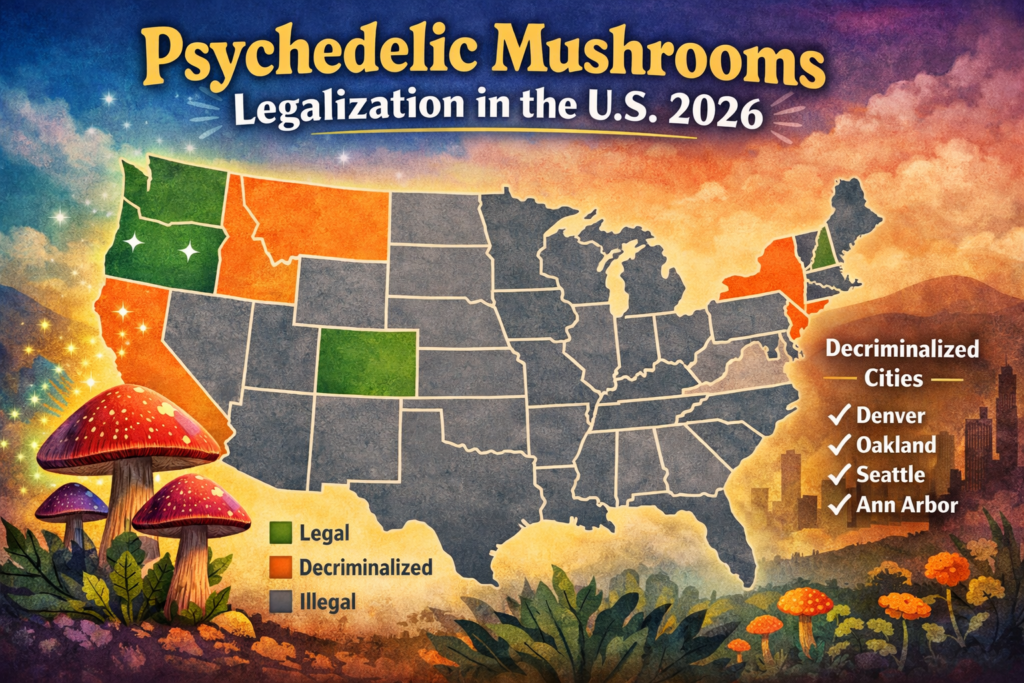
States Where Psychedelic Mushrooms Are Legal (Supervised Use)
1. Oregon
Oregon became the first state to legalize psilocybin for supervised use.
In 2020, voters passed Measure 109. As a result:
- Adults 21+ can legally access psilocybin services
- Use must occur at licensed service centers
- Licensed facilitators must supervise sessions
- Retail sales for home use remain illegal
Importantly, this is not recreational legalization. Instead, it allows regulated therapeutic-style sessions under state oversight.
Oregon also passed Measure 110, which decriminalized possession of small amounts of drugs, including psilocybin.
2. Colorado
Colorado followed Oregon’s lead in 2022.
Under Proposition 122:
- Psilocybin was decriminalized for adults 21+
- Personal cultivation and sharing (without payment) became legal
- A regulated healing center system is being developed
Retail commercial sales are not allowed. However, supervised access programs are expected to expand in coming years.
States Considering Legalization
Several states are exploring medical or supervised psilocybin programs. While not fully legal yet, legislative momentum is building in places such as:
- California
- Washington
- Massachusetts
Bills have been introduced, although some proposals have stalled. Therefore, laws may change quickly. Always verify current regulations before making decisions.
Cities That Have Decriminalized Psychedelic Mushrooms
Although state legalization remains limited, several cities have decriminalized psilocybin. Decriminalization typically means:
- Law enforcement treats possession as the lowest priority
- Arrests and prosecutions become rare
- Sales and distribution remain illegal
Here are notable examples:
Denver
Denver became the first U.S. city to decriminalize psilocybin in 2019.
Oakland
Oakland expanded decriminalization to include entheogenic plants and fungi.
Seattle
Seattle passed a resolution deprioritizing enforcement against psychedelic plant substances.
Ann Arbor
Ann Arbor declared investigation and arrest for entheogenic plants among the lowest law enforcement priorities.
Keep in mind: Decriminalization does not equal legalization. Commercial sales remain illegal in these cities.
Where Psychedelic Mushrooms Remain Illegal
In most U.S. states, psilocybin mushrooms are still fully illegal under state law. Possession, cultivation, and sale can result in criminal penalties.
Because federal law has not changed, transporting psilocybin across state lines remains a federal offense—even between states that have legalized supervised use.
Why Are Laws Changing?
Several factors are driving reform:
1. Medical Research
Research institutions have studied psilocybin for mental health conditions such as depression, PTSD, and anxiety. Clinical trials have shown promising results under controlled conditions.
2. Public Opinion
Public perception has shifted significantly over the past decade. As cannabis reform gained traction, interest in psychedelic policy reform increased as well.
3. Mental Health Crisis
States are exploring alternative therapies in response to rising mental health challenges nationwide.
Key Differences: Legalization vs Decriminalization
To understand where psychedelic mushrooms are legal in the United States, it is essential to distinguish:
| Term | Meaning |
|---|---|
| Legalization | State-regulated system allowing supervised access |
| Decriminalization | Reduced penalties; lowest enforcement priority |
| Illegal | Criminal penalties remain enforceable |
Currently, only Oregon and Colorado have passed statewide reforms allowing regulated access. Meanwhile, several cities have decriminalized possession.
Are Psychedelic Mushroom Spores Legal?
In many states, spores do not contain psilocybin. Therefore, they may be legal to purchase for microscopy purposes. However:
- Cultivating spores into psilocybin mushrooms is illegal in most states
- Laws vary by jurisdiction
- Some states restrict spores entirely
Always check local laws before purchasing.
Future Outlook: Will More States Legalize Psilocybin?
Momentum continues to grow. If current trends continue, additional states may implement:
- Medical psilocybin therapy programs
- Regulated supervised-use systems
- Broader decriminalization measures
However, federal reclassification would require action from Congress or the DEA.
Final Answer: Where Are Psychedelic Mushrooms Legal in the United States?
As of 2026:
- Psilocybin remains illegal under federal law
- Oregon allows supervised, licensed psilocybin services
- Colorado has decriminalized possession and is developing regulated access
- Several cities have decriminalized enforcement
- Most states still prohibit possession and sale
Because laws are evolving rapidly, always confirm the latest updates through official state resources before making decisions.
Disclaimer
This article is for informational purposes only and does not constitute legal advice. Laws change frequently. Consult a qualified attorney or official state resources for current information.
