
No products in the cart.
Blog
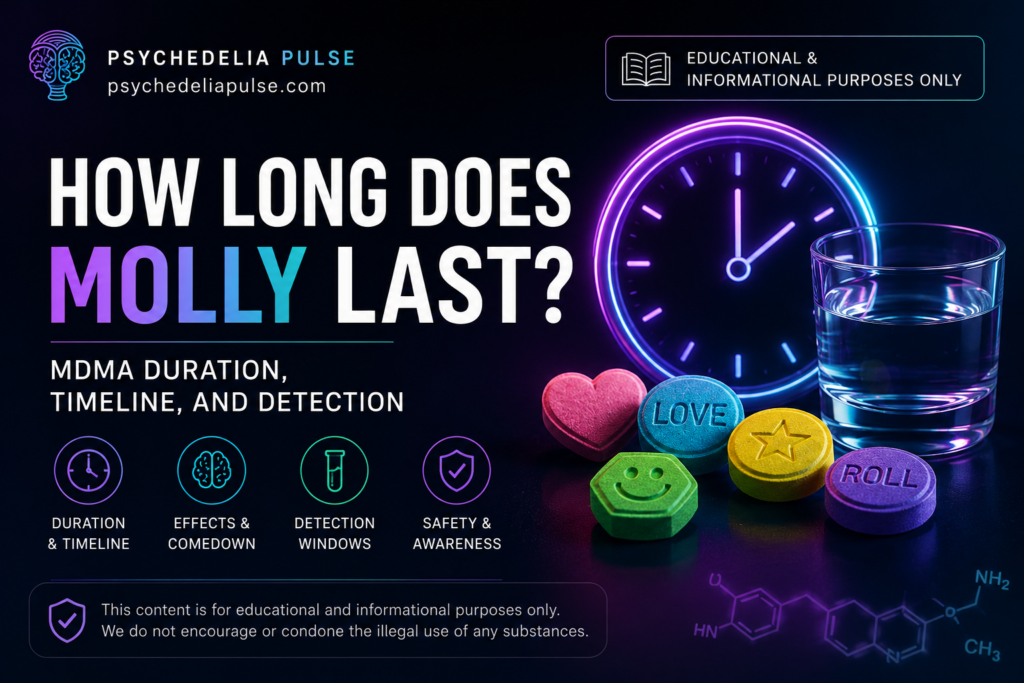
How Long Does Molly Last? MDMA Duration, Timeline, and Detection
26
Aug
Aug
How long does molly last depends on which question is actually being asked. The subjective high from oral MDMA typically spans 3–6 hours. The drug’s elimination half-life of roughly 7–9 hours means MDMA remains pharmacologically present well after the peak experience ends. Laboratory detection extends further still—days in urine, varying by specimen and method. These are three distinct clocks running simultaneously, and conflating them produces dangerous misunderstandings about redosing, driving, drug testing, and when to seek emergency care. This article addresses each dimension using published pharmacokinetic evidence.
Quick Answer: How Long Does Molly Last?
Molly (MDMA) typically produces noticeable effects for about 3–6 hours when taken orally, with onset commonly occurring within 30–60 minutes. MDMA has an elimination half-life of roughly 7–9 hours, so it remains in the body after the high ends. Drug-test detection lasts longer and varies by specimen, test, dose, and metabolism.
Definition — MDMA duration: The duration of molly’s effects is not a single number. It describes at minimum three overlapping but distinct phenomena: the acute intoxication window (roughly 3–6 hours), the residual physiological and psychological aftereffects that may persist for days, and the laboratory detection window, which extends beyond all subjective effects and varies by specimen and analytical method.
The three clocks framework: Every question about MDMA duration implicitly asks about one of three separate timelines:
- The high clock — how long the subjective effects are noticeable (roughly 3–6 hours)
- The elimination clock — how long the drug remains in the body (governed by the ~7–9 hour half-life)
- The detection clock — how long a laboratory test can identify the drug (days, depending on specimen and method)
A test can be positive when a person feels completely sober. A person can feel effects while still absorbing a dose. None of these clocks runs on the same schedule.
MDMA Timeline: From First Dose to Comedown
Understanding how long MDMA lasts requires a phase-by-phase framework. The following timeline reflects oral administration at typical recreational doses, based on human pharmacokinetic data from Kolbrich et al. (2008) and de la Torre et al. (2004).
| Phase | Typical timing | What occurs |
|---|---|---|
| Onset | 30–60 minutes after ingestion | Initial alertness, mild nausea possible, early entactogenic effects |
| Come-up | 60–90 minutes | Intensifying euphoria, increased heart rate, pupil dilation, jaw tension |
| Peak | 90 minutes to 3 hours | Maximum euphoria, empathy, sensory enhancement, cardiovascular stimulation |
| Plateau | Hours 2–4 | Effects stabilize then gradually decline |
| Offset | Hours 3–6 | Subjective high fades; residual stimulation continues |
| Comedown | Hours 6–24+ | Fatigue, insomnia, appetite suppression, possible low mood |
| Aftereffects | Days 1–3+ | Mood, sleep, appetite, and cognitive effects varying substantially by individual |
This timeline applies to a single oral dose of confirmed MDMA. Redosing, insufflation, higher quantities, drug interactions, adulterants, and individual metabolic variation all shift these parameters significantly.
Molly Onset Time: How Long Does It Take for Molly to Kick In?
Direct answer: Oral MDMA commonly begins producing noticeable effects within approximately 30–60 minutes, though individual onset varies. Food in the stomach delays gastric emptying and slows absorption. A delayed onset should never be interpreted as evidence that a product is weak or inactive—that misread is one of the primary drivers of dangerous unintentional redosing.
MDMA’s onset after oral ingestion reflects the time required for gastric absorption, first-pass hepatic metabolism, and sufficient plasma concentrations to produce CNS effects. Peak plasma concentrations following oral administration typically occur within one to three hours, as documented in Kolbrich et al. (2008).
Insufflated MDMA reaches peak plasma concentrations faster than oral administration because it partially bypasses gastric absorption. However, bioavailability differences between routes do not eliminate the period before meaningful CNS effects begin, and insufflation introduces additional health risks without a corresponding safety benefit.
Clinical implication of onset variability: Because onset can range from 20 minutes to 90 minutes or longer depending on food, dose, formulation, and the actual contents of an illicit product, waiting for perceived effects before deciding whether a dose “worked” is unreliable and potentially dangerous. An illicit product’s contents—not its timing—determine whether any MDMA pharmacokinetics apply at all.
Molly Peak Duration: The Height of the High
Direct answer: MDMA’s peak effects—maximum euphoria, empathogenic experience, and sensory enhancement—generally occur during the first one to three hours following onset, corresponding to the period of highest plasma concentrations and maximal monoamine release.
MDMA’s mechanism involves releasing serotonin, dopamine, and norepinephrine from nerve terminals by reversing the direction of their respective monoamine transporters—particularly the serotonin transporter (SERT)—rather than simply blocking reuptake. This flood of monoamine release, especially serotonin, accounts for the characteristic entactogenic and empathogenic effects that distinguish MDMA from conventional stimulants, as reviewed in Nichols (2022).
Peak monoamine release coincides with peak plasma MDMA concentrations. As concentrations decline through hepatic metabolism—primarily via CYP2D6 and related pathways—the subjective quality of the experience shifts from euphoric peak toward residual stimulation and then aftereffects.
The peak phase is also the period of greatest cardiovascular stress: heart rate, blood pressure, and body temperature are measurably elevated, and the risk of hyperthermia—particularly in hot, physically demanding environments—is highest during peak drug effect.
How Long Does a Molly High Last: Total Effect Duration
Direct answer: The subjective high from a single oral dose of MDMA commonly lasts approximately 3–6 hours, reflecting the acute intoxication period during which euphoria, empathy enhancement, and sensory effects are prominent. Residual stimulation—wakefulness, appetite suppression, mild cardiovascular effects—may continue after peak euphoria has subsided.
The 3–6 hour estimate is consistent across multiple controlled human pharmacokinetic studies and reflects typical recreational doses. This range is not a fixed guarantee:
- Higher doses extend duration and increase residual effects while substantially elevating risk of serious adverse outcomes
- Redosing extends the total intoxication window unpredictably and is associated with higher rates of adverse effects, particularly cardiovascular and hyperthermic complications—a pharmacokinetic pattern discussed in the redosing section below
- Drug interactions can significantly alter both intensity and duration—MAOI combinations can produce life-threatening serotonin toxicity; some serotonergic antidepressants may alter subjective effects through transporter and serotonergic mechanisms
- Adulterants mean that the actual duration of an illicit product may have nothing to do with MDMA pharmacokinetics if the product does not contain MDMA
Feeling the high fade does not indicate that the drug has been eliminated. MDMA’s half-life of roughly 7–9 hours means significant drug concentrations persist well after the perceived experience ends—a gap that matters for decisions about driving, redosing, and other activities.
How Long Does Molly Last Compared With Its Half-Life?
Direct answer: The MDMA high, elimination half-life, and drug-test window measure different things. The noticeable high commonly lasts about 3–6 hours, while MDMA’s elimination half-life is roughly 7–9 hours. Laboratory detection may continue after intoxication ends. A positive test therefore does not establish that a person is currently high or impaired, and feeling sober does not establish that the drug has cleared.
MDMA Half Life: Understanding Drug Elimination
Published human pharmacokinetic studies place MDMA’s elimination half-life at roughly 7–9 hours, as documented in de la Torre et al. (2004). After approximately five half-lives, roughly 97% of the starting amount would be eliminated under a simplified first-order model—but MDMA pharmacokinetics are more complex than first-order elimination, so this calculation is an illustration rather than a personal clearance prediction.
MDMA undergoes extensive hepatic metabolism, with CYP2D6 playing a central role. The primary metabolite MDA (3,4-methylenedioxyamphetamine) is pharmacologically active and present in measurable quantities after MDMA administration, contributing to detection windows—though its concentration is substantially lower than the parent compound and should not be characterized as a primary driver of prolonged subjective effects without direct human evidence. CYP2D6 metabolizer status varies genetically across individuals, producing clinically meaningful differences in MDMA clearance rates, as documented in de la Torre et al. (2004).
High vs. half-life vs. detection: a comparison
| Measure | Approximate timeframe | What it represents |
|---|---|---|
| Subjective high | 3–6 hours | Perceived intoxication period |
| Residual effects | Hours 6–24+ | Fatigue, insomnia, altered mood |
| Elimination half-life | ~7–9 hours | Time for plasma concentration to halve |
| Urine detection | ~2–4 days (approximate) | Laboratory-detectable presence |
| Hair detection | Weeks to months | Historical exposure pattern |
A positive MDMA test does not mean a person is currently high or impaired. Detection and impairment measure different things. Similarly, feeling sober does not by itself establish fitness to drive or make consequential decisions, because subjective sobriety and pharmacological clearance are not equivalent.
How Redosing Changes MDMA Duration
Redosing is pharmacologically important for a reason most consumer content does not address: MDMA exhibits nonlinear pharmacokinetics, in part because the drug inhibits CYP2D6—the same enzyme primarily responsible for its metabolism. This autoinhibition means that a second dose taken while the first is still present does not behave like an independent dose; it is metabolized more slowly than the first, producing higher plasma concentrations than simple dose arithmetic would predict, as documented in de la Torre et al. (2004).
The practical consequences are significant: redosing elevates peak plasma concentrations, extends the elimination timeline, increases cardiovascular and hyperthermic burden, and substantially prolongs the detection window—all while the subjective sense that the dose “wore off” may have prompted the redose in the first place.
Molly Comedown Duration and Aftereffects of Molly: How Long Do They Last?
Direct answer: Post-MDMA fatigue, sleep disruption, low mood, appetite changes, or difficulty concentrating may persist for one or more days following use. These aftereffects are multifactorial and should not be described as a fixed “serotonin depletion” or predictable “serotonin recovery” period—duration varies considerably by individual, dose, frequency of use, and concurrent substances.
The colloquially described “Tuesday blues”—low mood in the days after weekend MDMA use—reflects a recognized pattern in user reports. However, attributing it solely to “serotonin depletion” oversimplifies a complex picture. Sleep deprivation, physical exertion, dose, repeated exposure, other substances, and individual neurobiological variation all contribute to post-MDMA aftereffects in ways that human pharmacokinetic research has not fully disentangled, as discussed in Parrott (2013).
Claims about a specific-day “serotonin recovery window” that circulate in harm-reduction content represent useful general guidance rather than established pharmacological timelines. The actual time course of monoamine resynthesis, transporter regulation, and neuroadaptation after MDMA use in humans has not been characterized with the precision that day-by-day recovery claims imply.
How Long Does Molly Stay in Your System: Detection Windows
Direct answer: MDMA can remain measurable in laboratory testing after its subjective effects have completely ended. Detection time varies by specimen, analytical method, cutoff concentration, dose, repeated exposure, individual metabolism, and other factors. The subjective high and the drug-test detection window are not the same measurement, and treating them as equivalent can lead to consequential errors in judgment.
How Long Does MDMA Stay in Urine?
Direct answer: MDMA and its metabolites may remain detectable in urine for approximately 2–4 days following single recreational doses under typical testing conditions, as reviewed in Verstraete (2004). This is an approximate population-level range, not a reliable personal threshold.
Urine immunoassay testing is the most common MDMA screening method in workplace and forensic contexts. Immunoassays screen for compounds above a defined cutoff; positive results are typically confirmed by GC-MS or LC-MS/MS, which provide definitive chemical identification. A positive immunoassay alone is a presumptive finding, not a confirmed identification.
Urinary pH influences the renal elimination of amphetamine-type compounds: as weak bases, MDMA and its metabolites are excreted more readily in acidic urine and retained longer in alkaline urine—a pharmacokinetic principle relevant to elimination rate, though its effect on detection window varies by analytical method and cutoff concentration.
Detection windows are not fixed at 2–4 days. Higher doses, repeated use, alkaline urine, low urine output, highly sensitive assays, or lower laboratory cutoff concentrations can all extend detectability. Federal workplace drug-testing programs, private workplace panels, and clinical toxicology tests may use different panels, cutoffs, and confirmation requirements.
Molly Blood Test Duration
Blood testing detects MDMA based on plasma concentrations, which decline according to the elimination half-life. Blood has a shorter detection window than urine—generally hours to approximately one to two days after a single dose—making it more useful for establishing recent exposure than for detecting use from prior days. Blood testing is most commonly used in clinical emergencies and forensic investigations rather than routine workplace screening.
MDMA Saliva Test Duration
Oral fluid testing has a detection window that roughly parallels plasma concentrations, useful for detecting recent MDMA use—generally within hours to approximately one day of ingestion. Oral fluid testing is increasingly used in roadside impairment assessments because it reflects recent rather than historical exposure. As reviewed in Verstraete (2004), oral fluid MDMA concentrations peak shortly after ingestion and decline relatively rapidly.
MDMA Hair Testing
Hair follicle testing provides the longest retrospective detection window—potentially weeks to months—because MDMA and metabolites incorporate into growing hair from the bloodstream. Approximately 1 cm of hair growth corresponds to roughly one month of history. Hair testing characterizes patterns of use over extended periods rather than detecting recent single-dose exposure. Recognized methodological limitations include environmental contamination and variability in drug incorporation related to melanin content.
| Specimen | Approximate detection window | Primary use |
|---|---|---|
| Urine | ~2–4 days (varies substantially) | Workplace screening; forensic |
| Blood | Hours to ~1–2 days | Clinical emergency; forensic |
| Saliva/oral fluid | Hours to ~1 day | Roadside impairment; recent exposure |
| Hair | Weeks to months | Historical use patterns |
All detection windows are approximate ranges based on population-level data. Individual results may fall outside these ranges, and no detection window estimate should be used to predict whether a specific person will pass or fail a specific test.
Does a Positive MDMA Test Mean You Are Still High?
No. Detection and impairment measure fundamentally different things. A positive MDMA urine test may reflect exposure that occurred days earlier, well after subjective effects resolved. Conversely, someone may be impaired while a test is still negative if concentrations fall below the assay cutoff. Neither a positive nor a negative test result establishes current impairment or fitness to perform safety-sensitive tasks.
MDMA Duration Curve: How Effects Change Over Time
MDMA’s effect profile is not static across its duration. The qualitative character of the experience shifts as plasma concentrations rise, peak, and decline—a pattern with direct relevance to both harm reduction and clinical assessment.
During the come-up, serotonin release dominates the initial experience, producing anxiety or stimulation alongside emerging euphoria. Some individuals experience nausea, restlessness, or dysphoria during this phase.
At peak, the combined monoamine release produces the characteristic MDMA profile: euphoria, emotional openness, sensory enhancement, tachycardia, hypertension, mydriasis, and elevated body temperature. The entactogenic and empathogenic quality—the subject of ongoing therapeutic research—is maximal during this phase.
As the drug offsets, the euphoric and empathogenic components fade faster than residual stimulant effects driven by dopamine and norepinephrine. This asymmetry—rewarding aspects declining before stimulation—contributes to the pattern of redosing that elevates adverse event risk, precisely because users may pursue the waning euphoria without recognizing that physiological burden has not similarly declined.
The comedown reflects acute neurochemical and physiological changes following the drug’s active phase: fatigue, mood changes, and disrupted sleep rather than withdrawal in the pharmacological sense.
Adulterants and Real MDMA Duration
The pharmacokinetic timeline described in this article applies to confirmed MDMA. Illicit products sold as molly or ecstasy may contain other substances—synthetic cathinones, methamphetamine, other stimulants, or in some markets, opioids—and the presence of other compounds fundamentally alters the duration, intensity, and risk profile of the experience. Drug composition varies by market and geographic region, and population-level adulteration data should be interpreted in that context rather than generalized nationally.
Reagent tests and fentanyl test strips are targeted harm-reduction screening tools with important limitations. They cannot establish purity or fully characterize a sample. Laboratory techniques such as GC-MS or LC-MS/MS provide substantially more specific compound identification. The DanceSafe organization and similar harm-reduction services offer drug-checking resources and guidance on interpreting results.
The practical implication for duration assessment is direct: MDMA pharmacokinetic data cannot be applied to an unknown substance sold as MDMA. Duration, risk profile, and emergency treatment requirements are determined by what the product actually contains.
Dangerous Drug Interactions Affecting MDMA Duration and Risk
Several drug combinations substantially alter MDMA’s safety profile—some producing emergencies that can be mistaken for an unusually intense or prolonged experience.
MAOIs (monoamine oxidase inhibitors): Combining MDMA with MAOIs—including certain antidepressants and the antibiotic linezolid—can produce life-threatening serotonin toxicity by impairing metabolic breakdown of serotonin. This is among the most dangerous documented MDMA interactions, as reviewed in Gillman (2010).
SSRIs and SNRIs: Some SSRIs can substantially attenuate MDMA’s subjective effects through serotonergic and transporter mechanisms. Interactions vary by specific medication. Abruptly stopping prescribed antidepressants to use MDMA is unsafe and can create separate medical risks independent of any MDMA effect.
Stimulants: Additive cardiovascular effects—tachycardia, hypertension, elevated body temperature—substantially elevate cardiac and hyperthermic risk.
Alcohol: Masks perceptions of dehydration and heat, contributing to hyperthermia and hyponatremia risk while adding CNS depressant effects that complicate clinical assessment.
Other serotonergic substances: Tramadol, lithium, and triptans each carry specific interaction risks documented in clinical literature. These combinations can lower seizure threshold or compound serotonergic burden in ways that amplify adverse event risk.
How Long Does Ecstasy Last: MDMA Tablets vs. Molly Powder
The terms “molly” and “ecstasy” describe different formulations—typically powder or crystalline MDMA versus compressed tablets—but the underlying pharmacokinetics apply to the same molecule when the product actually contains MDMA.
Formulation differences can affect onset and peak timing at the margin: tablets require dissolution before absorption, while powder may dissolve faster. These differences are secondary to the more consequential variable of what the product actually contains and at what dose.
Ecstasy tablets have historically shown substantial variability in MDMA content, with some tablets containing no MDMA and others containing doses far exceeding typical recreational amounts, as documented in drug-checking analyses reviewed in Cole et al. (2002). A tablet with an unexpectedly high MDMA dose produces a substantially different duration and risk profile than one with a typical dose—which is why drug-checking provides meaningful harm-reduction value even when it cannot guarantee safety.
Physical Effects: How Long Do MDMA’s Physiological Effects Last?
MDMA’s physical effects follow a somewhat different timeline than its subjective psychological effects, and several physiological parameters remain measurably altered after the subjective high has faded.
Cardiovascular effects: Heart rate and blood pressure elevations track closely with plasma MDMA concentrations, generally returning toward baseline as the drug is metabolized. Cardiovascular stress is highest during peak plasma concentrations and is exacerbated by physical exertion, heat, and stimulant drug combinations.
Hyperthermia: Elevated body temperature is among MDMA’s most clinically dangerous physiological effects. It results from combined mechanisms: increased metabolic heat production, sympathomimetic stimulation, and serotonin-mediated impairment of normal thermoregulation. In hot environments with sustained physical exertion, hyperthermia can escalate to organ-threatening levels faster than the individual recognizes, as documented in Hall and Henry (2006). Severe hyperthermia can lead to rhabdomyolysis (skeletal muscle breakdown with nephrotoxic myoglobin release), disseminated intravascular coagulation, acute kidney injury, and multi-organ dysfunction.
Mydriasis: Pupil dilation reflects ongoing sympathomimetic effects rather than peak euphoria specifically and may persist beyond the subjective high. Pupil size is also affected by ambient lighting, co-ingested substances, and medications, making it an unreliable standalone indicator of current intoxication status.
Bruxism: Jaw tension and teeth-grinding may persist through the offset and early aftereffect phases.
Hyponatremia: Dangerous low blood sodium—typically from excessive hypotonic fluid intake combined with MDMA-related antidiuretic hormone (ADH/vasopressin) dysregulation—represents a particular risk during and after peak effects. Risk is elevated in female-sex individuals and in settings involving prolonged physical activity, as reviewed in Hall and Henry (2006). Headache, nausea, confusion, or seizures following heavy water consumption during or after MDMA use require emergency evaluation.
What Happens in the ER After an MDMA Emergency?
Emergency evaluation of suspected severe MDMA toxicity is driven by clinical presentation rather than an MDMA level. Standard urine drug screens do not reliably detect MDMA; specialized LC-MS/MS can identify it but is rarely available in time to guide acute treatment decisions.
For patients presenting with severe symptoms, emergency clinicians typically evaluate:
- Core body temperature: Essential for identifying and tracking hyperthermia, which requires immediate active cooling
- Electrolytes and serum sodium: To identify hyponatremia, which can cause seizures, cerebral edema, and death
- Renal function: To monitor for acute kidney injury, particularly when rhabdomyolysis is suspected
- Creatine kinase (CK): The primary laboratory marker for rhabdomyolysis; markedly elevated levels indicate muscle breakdown requiring aggressive IV hydration
- Hepatic function: Relevant when hyperthermia, rhabdomyolysis, or multi-organ involvement is present
- ECG: To detect arrhythmias or QT prolongation, particularly when stimulant co-ingestion or MDMA at high doses is possible
- Comprehensive toxicology: To identify adulterants, co-ingestants, or alternative diagnoses—particularly relevant when the substance identity is uncertain
Emergency treatment is primarily supportive: rapid cooling for hyperthermia, correction of electrolyte abnormalities including sodium for hyponatremia, benzodiazepines for seizures and severe agitation, IV fluids with careful monitoring for rhabdomyolysis and renal injury, and ECG-guided management of cardiovascular instability. There is no specific MDMA antidote. Poison Control (1-800-222-1222) provides 24-hour guidance for both lay callers and medical professionals managing suspected MDMA presentations.
When to Seek Emergency Care After MDMA Use
Call 911 for any of the following during or after MDMA use:
- Seizures or convulsions
- Loss of consciousness or unresponsiveness
- Severe agitation, confusion, or disorientation
- Difficulty breathing or chest pain
- Signs of severe overheating: hot skin, cessation of sweating, collapse
- Headache, vomiting, confusion, or seizures suggesting hyponatremia from excess water intake
- Suspected serotonin syndrome: agitation, tremor, clonus, muscle rigidity, elevated temperature
Emergency and support resources:
- Emergency services: 911
- Poison Control: 1-800-222-1222 (US, 24 hours; advises clinicians and the public)
- SAMHSA National Helpline: 1-800-662-4357 (24-hour treatment referrals)
- 988 Suicide & Crisis Lifeline: Call or text 988
Good Samaritan laws in many US states provide limited legal protection when emergency help is called for a drug-related situation. Fear of legal consequences should not prevent a call for emergency care.
Frequently Asked Questions: MDMA Duration
Q: How long does molly last?
A: The noticeable effects of orally consumed molly (MDMA) commonly last about 3–6 hours. Residual stimulation, difficulty sleeping, fatigue, and other aftereffects may continue longer. Duration varies with dose, metabolism, food, medications, repeated dosing, and whether the illicit product actually contains MDMA.
Q: How long does it take for molly to kick in?
A: Oral MDMA commonly begins producing noticeable effects within approximately 30–60 minutes, though onset varies. Food can delay absorption substantially, and a delayed onset should not be interpreted as evidence that a product is weak or inactive—that misread is a primary cause of dangerous unintentional redosing.
Q: What is the half-life of MDMA?
A: Published human pharmacokinetic studies place MDMA’s elimination half-life at roughly 7–9 hours, as documented in de la Torre et al. (2004). Half-life measures how quickly plasma drug concentrations decline; it does not indicate how long someone feels high or precisely when a drug test will become negative.
Q: How long does molly stay in your system?
A: MDMA can remain measurable after its subjective effects have ended. Detection time varies by specimen, laboratory method, cutoff concentration, dose, repeated exposure, and individual metabolism. The subjective high and the laboratory detection window are not the same measurement.
Q: How long does MDMA stay in urine?
A: MDMA and its metabolites may remain detectable in urine for approximately 2–4 days following single recreational doses under typical testing conditions, as reviewed in Verstraete (2004). This window varies substantially with dose, repeated use, urinary pH, specimen concentration, assay sensitivity, and laboratory cutoffs.
Q: How long does a molly comedown last?
A: Fatigue, sleep disruption, low mood, appetite changes, or difficulty concentrating may persist for one or more days. These aftereffects are multifactorial—not reducible to a fixed “serotonin depletion” timeline—and vary considerably by individual, dose, frequency of use, and concurrent substances.
Q: How long do pupils stay dilated after taking molly?
A: Mydriasis can continue during MDMA’s active and residual sympathomimetic effects and may outlast peak euphoria. There is no reliable fixed duration—pupil size is also affected by ambient lighting, other substances, medications, and individual physiology.
Q: When should you seek emergency care after taking MDMA?
A: Call 911 for seizures, loss of consciousness, severe confusion or agitation, difficulty breathing, chest pain, collapse, or suspected severe overheating. Headache, vomiting, confusion, or seizures following heavy water consumption may indicate dangerous hyponatremia and also require emergency evaluation.
Conclusion
How long does molly last depends on which clock is being consulted. The subjective high from a single oral dose of MDMA typically spans 3–6 hours, but MDMA’s elimination half-life of roughly 7–9 hours means the drug remains pharmacologically present well beyond the peak experience. Residual effects—fatigue, disrupted sleep, mood changes—can extend into subsequent days. Laboratory detection extends further still, with urine testing capable of identifying MDMA for approximately 2–4 days under typical conditions, and hair testing providing historical exposure data spanning months.
The three-clocks framework—high, elimination, detection—resolves most of the confusion that makes MDMA duration a clinically dangerous topic. Treating the end of the perceived high as equivalent to drug clearance is a primary driver of dangerous redosing, because CYP2D6 autoinhibition means a second dose is metabolized substantially more slowly than the first. Treating a negative drug test as equivalent to sobriety, or a positive test as evidence of current impairment, conflates detection with pharmacological presence and impairment with pharmacokinetics.
For anyone experiencing seizures, severe overheating, loss of consciousness, chest pain, or signs of hyponatremia or serotonin syndrome after MDMA use, 911 is the appropriate call. Poison Control (1-800-222-1222) advises on non-emergency concerns and guides clinical management. SAMHSA’s National Helpline (1-800-662-4357) connects callers with treatment resources around the clock.
