
No products in the cart.
Blog
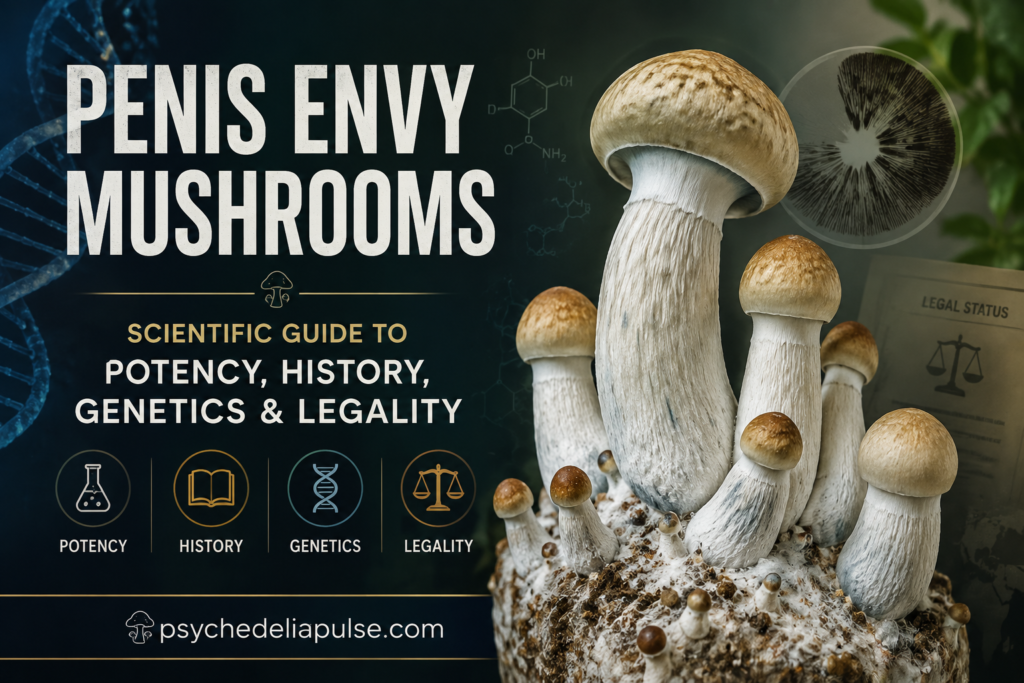
Penis Envy Mushrooms: Scientific Guide to Potency, History, Genetics & Legality
15
Aug
Aug
Penis Envy mushrooms are a named lineage of Psilocybe cubensis associated with a thick stipe, compact cap, limited visible sporulation and a reputation for high potency. Individual laboratory-tested samples support that reputation, but PE is not chemically standardized, and no scientific evidence establishes that every specimen is two or three times stronger than conventional P. cubensis.
The modern PE phenotype is widely recognized, but its early lineage history is less certain. Accounts involving Terence McKenna, Steven H. Pollock and Richard Gutierrez (“Rich Gee”) rest partly on retrospective testimony rather than a continuous genetic or documentary chain of custody. This guide therefore separates measured chemistry, documented history and community claims rather than treating them as equivalent evidence.
It covers PE potency, chemical composition, origin history, related lineages including Albino Penis Envy (APE), microscopy, effects, harm reduction and US law. It does not provide cultivation instructions.
Educational notice: This resource is intended for adults 21+ and provides general scientific, legal and harm-reduction information. Psilocybin and psilocin remain Schedule I controlled substances under federal law in the United States. State and local rules vary and change. Verify current law from primary sources before relying on any statement here.
Definition: Penis Envy (PE) is a named cultivar or lineage of Psilocybe cubensis, a basidiomycete mushroom species in the family Hymenogastraceae capable of producing psilocybin and related tryptamine compounds. PE is associated with a thick-stemmed phenotype and reduced spore deposition. Laboratory-tested samples have contributed to its high-potency reputation, but chemistry varies substantially between individual specimens, and the cultivar name is not a concentration measurement.
How We Evaluated the Evidence
This guide uses an explicit evidence hierarchy rather than treating laboratory data, historical recollections, vendor descriptions and online consensus as equivalent sources.
Evidence confidence labels used throughout:
- High confidence: Supported by primary law, robust peer-reviewed evidence or a directly applicable validated measurement with documented methodology.
- Moderate confidence: Supported by credible but incomplete or indirect evidence, such as limited samples or retrospective accounts corroborated by contemporaneous detail.
- Low/uncertain confidence: Dependent primarily on retrospective community accounts, uncited genealogy or vendor provenance claims without independent corroboration.
For PE specifically, this creates four distinct questions that no single method answers simultaneously:
- Laboratory testing establishes the chemistry of the specific specimen tested.
- Microscopy describes observable fungal structures.
- Genetic analysis can address particular questions about biological relatedness.
- Historical records can support provenance where documentation exists.
None of these methods automatically answers the others. A PE potency result tells you about one specimen. A spore micrograph tells you about observable morphology. A lineage account tells you what sources say, at whatever level of documentation those sources represent.
Quick facts:
| Attribute | Detail |
|---|---|
| Species | Psilocybe cubensis (Earle) Singer, family Hymenogastraceae |
| Common name | Penis Envy |
| Abbreviation | PE |
| Typical phenotype | Thick stipe, relatively compact pileus |
| Major psychoactive compounds | Psilocybin (4-PO-DMT) and psilocin (4-HO-DMT) |
| Other reported tryptamines | Baeocystin, norbaeocystin (presence reported; human pharmacological significance not established) |
| Potency | Variable; the cultivar name is not a concentration measurement |
| Related lineage names | APE, Melmac/Homestead PE, PE6, PE Uncut, Tidal Wave |
| Sporulation | Commonly reported as less prolific than conventional P. cubensis phenotypes |
| US federal status | Psilocybin and psilocin: Schedule I, 21 U.S.C. § 812; 21 C.F.R. § 1308.11 |
| Legal review date | August 2026 — verify against current primary sources |
Key evidence takeaway: A cultivar label cannot substitute for chemical analysis. Two specimens sold under the same name can differ significantly in alkaloid composition. Competition datasets tend to overrepresent specimens selected specifically for exceptional potency. Batch-specific analytical results with documented methodology are more informative than any universal PE potency multiplier.
What Are Penis Envy Mushrooms?
Quick answer: Penis Envy mushrooms are a widely circulated named lineage of Psilocybe cubensis whose modern phenotype is recognizable but whose early provenance is incompletely documented. They are generally identifiable by unusually thick stems and compact caps. They are widely described as highly potent, but potency varies and cannot be determined reliably from appearance or a strain name alone.
Is Penis Envy a Species, Strain, Cultivar or Phenotype?
“Penis Envy” is not a formally recognized separate mushroom species. In popular mycology it is most often called a strain; “cultivar,” “lineage” or “phenotype” can each be more precise depending on context. Psilocybe cubensis is the species. Names such as Penis Envy and Golden Teacher describe cultivated lines rather than taxonomic varieties established under formal mycological nomenclature.
Two samples labeled “PE” and “Golden Teacher” may look noticeably different while both belonging to P. cubensis. Taxonomic identity and commercial strain identity answer different questions, and species identification does not independently authenticate a vendor’s lineage claim.
Writing Psilocybe cubensis var. “Penis Envy” implies a formally described taxonomic variety that does not appear in the accepted scientific record. Best practice is to use “Penis Envy (PE), a named P. cubensis lineage/cultivar.”
[Confidence: High — species identification. Low/uncertain — commercial lineage provenance.]
Where Does Penis Envy Fit Within Psilocybe cubensis?
Psilocybe cubensis is a basidiomycete in the family Hymenogastraceae capable of producing psilocybin and related tryptamine compounds. PE is nested within this species. Psilocybin extracted from a PE specimen and psilocybin extracted from any other P. cubensis lineage are the same chemical compound — 4-phosphoryloxy-N,N-dimethyltryptamine (PubChem CID 10624).
A named cultivar may show repeatable phenotypic tendencies without every individual expressing an identical appearance or chemical profile. Strain names should never be treated as pharmaceutical formulations with standardized concentrations.
Three questions deserve separate answers: What species is this? What lineage is claimed? What does laboratory testing show?
How Can Penis Envy Mushrooms Be Identified?
PE is commonly associated with a disproportionately thick, dense stipe and a compact pileus. Individual morphology varies, and visual appearance alone cannot authenticate genetics.
A thick-stemmed P. cubensis fruiting body is not automatically “Penis Envy,” and phenotype describes observable traits rather than confirming genetic ancestry. Blue bruising is neither a definitive identifier nor a potency meter — its chemistry is discussed under alkaloids below.
Internet photographs are insufficient for identifying any mushroom intended for consumption. Misidentification of wild fungi can have consequences entirely unrelated to psilocybin.
Why Does PE Often Produce Few Spores?
PE is widely noted in cultivated collections for limited visible spore deposition and atypical cap and veil development relative to conventional P. cubensis phenotypes. The precise genetic mechanisms have not been established through published genetic evidence, and the claim that a reduced veil directly causes elevated psilocybin concentration has not been demonstrated scientifically.
[Confidence: Moderate — sporulation phenotype is widely reported. Low/uncertain — genetic mechanism.]
What Makes Penis Envy Different From Typical P. cubensis?
Quick answer: PE differs most visibly in morphology and sporulation. Its thick-stemmed phenotype is unusual among P. cubensis lines, and selected laboratory results support a potency reputation. Appearance, density and bruising still cannot tell you how much psilocybin any individual specimen contains.
How Do the Stipe, Pileus and Veil Differ?
Classical PE descriptions emphasize a robust stipe, comparatively small cap and atypical or reduced veil characteristics. Golden Teacher, by contrast, typically presents the broader-cap, slender-stipe proportions most commonly associated with P. cubensis generally.
Morphology is shaped by both genetics and environmental expression, making phenotype useful but imperfect. Characteristic ranges are more honest than presenting a single image as a diagnostic fingerprint.
Can Appearance Prove the PE Genotype?
Genotype describes genetic constitution; phenotype describes observable expression. Similar phenotypes can arise from different lineages, while related genetic material can express differently under varying conditions.
An unusually thick P. cubensis fruiting body is not automatically “Penis Envy.” Reliable provenance depends on documented lineage and, where appropriate, genetic evidence — not visual similarity or branding.
Are Dense Penis Envy Mushrooms Necessarily More Potent?
Physical density is not a validated proxy for psilocybin content. Laboratory chemistry is required to quantify compounds. Two visually similar PE specimens can produce different HPLC measurements, and even if density correlated with potency in a particular dataset, that correlation would not establish that dense tissue causes enhanced alkaloid biosynthesis.
[Confidence: High — claim that density does not reliably predict potency.]
Where Did Penis Envy Mushrooms Come From?
Quick answer: The Penis Envy strain origin is not documented well enough to name one undisputed creator. Stories commonly connect Terence McKenna, physician and mycologist Steven H. Pollock, and Richard Gutierrez (“Rich Gee”) to the lineage. Much of the familiar account rests on retrospective testimony and community history rather than a continuous primary-source record.
Evidence-confidence timeline:
| Period | Claimed event | Primary documentation | Confidence |
|---|---|---|---|
| Early 1970s | McKenna associated with Amazonian P. cubensis collection | Retrospective accounts; no contemporaneous specimen record identified | Low/uncertain |
| Mid-1970s | Pollock reported to select or possess unusual PE-type material | Retrospective accounts; contemporaneous documentation not publicly established | Low/uncertain |
| Late 1970s–1980s | Rich Gee reported to name, stabilize and distribute PE | Retrospective community accounts; original cultivation records not publicly available | Low/uncertain |
| Post-2000 | PE widely distributed in hobbyist networks | Community documentation; commercial availability | Moderate |
| 2000s–present | APE, Melmac, Tidal Wave and other derivatives named | Breeder and community records; genealogical verification varies | Low–moderate |
What Is the Terence McKenna Origin Story?
The widely repeated claim connects early PE genetics to mushroom material associated with Terence McKenna and Amazonian collections. Culturally, the story is significant. Evidentially, repeated publication does not convert an oral or retrospective narrative into documented provenance.
A modern article may state that McKenna “created Penis Envy” even though the fuller account attributes later selection and distribution to other figures. Historical confidence should track source quality, not the number of websites repeating a claim.
What Role Is Steven Pollock Said to Have Played?
Steven H. Pollock was a physician and mushroom researcher. Retrospective accounts commonly assign him a role in selecting or possessing unusual P. cubensis material that became associated with PE. His published scientific work on Psilocybe species represents the most accessible contemporaneous documentation of his mycological activity, though it does not directly confirm the PE lineage claims made in community histories.
[Confidence: Low/uncertain — specific PE-related role depends on retrospective sources without publicly established contemporaneous documentation.]
What Role Did Richard Gutierrez Play?
Richard Gutierrez, known in the PE story as Rich Gee, is associated in retrospective accounts with distributing the recognizable lineage — and in some versions with its naming and selection. Accounts differ: some describe “stabilization,” others emphasize distribution. “Stabilized” carries a specific genetic implication and should not be used without the generational cultivation records that would support it.
[Confidence: Low/uncertain — retrospective community sources; accounts vary.]
What Is Documented and What Remains Lore?
The PE origin story contains meaningful retrospective history and genuine uncertainty in roughly equal measure. This does not make the oral history worthless, but it does change how confidently individual claims should be stated.
A dated document can establish that a person possessed particular material at a particular time without proving that material’s complete genetic ancestry. The most useful lineage account attaches a confidence level to each claim rather than hiding uncertainty behind an authoritative tone.
PE’s disputed provenance is itself informative. It illustrates a broader problem with legacy mushroom strain genealogy: community names often predate the documentation standards that would now be expected for any biological collection. That gap between informal naming and verifiable provenance is not unique to PE — it characterizes informal cultivar culture generally.
How Potent Are Penis Envy Mushrooms?
Quick answer: Individual laboratory-tested PE-family specimens support the possibility of high alkaloid concentrations. No universal PE psilocybin percentage or 2x–3x multiplier applies to every specimen. Why are Penis Envy mushrooms said to be so strong? The short answer is that the most potent PE samples recorded are genuinely high — but record values are not averages.
To understand how strong Penis Envy mushrooms actually are, it helps to distinguish three related but separate concepts:
- Chemical potency = measured alkaloid concentration in a specimen (expressed as a percentage of dry weight).
- Pharmacological exposure = the actual amount of active compound reaching the person, shaped by dose, preparation and individual metabolism.
- Subjective intensity = experienced effects, further shaped by expectations, setting and individual biology.
A cultivar name speaks to none of these with precision. Batch-specific analytical results with documented methodology are the only reliable starting point.
What Do Laboratory and Psilocybin Competition Results Actually Show?
Laboratory results establish the alkaloid concentration of the specimens tested. They cannot, by themselves, establish an average for every mushroom carrying the same lineage name. This matters most for competition datasets — such as those published by Oakland Hyphae — where entrants may deliberately submit unusually strong specimens.
A useful PE dataset should report every included specimen, not only record holders. It should identify the testing laboratory, analytical method, units, sample condition and lineage provenance. For each comparable group, publish the sample count, median, range and interquartile range.
Evidence table — illustrative structure:
| Sample ID | Lineage claimed | Lab/method | Psilocybin (% DW) | Psilocin (% DW) | Total alkaloids | Source/date |
|---|---|---|---|---|---|---|
| [Awaiting verified data] |
Note: This table will be populated with source-verified, laboratory-documented PE specimen results prior to indexing. Until that data is editorially confirmed, this table identifies the structure required for a scientifically defensible comparison.
The most important original analysis compares the distribution of PE results — median, range and spread — with a defined non-PE P. cubensis comparison group analyzed by comparable methods. A record value answers “How potent was this specimen?” It does not answer “How potent is Penis Envy as a lineage?”
[Confidence: Moderate — the existence of high PE competition results is documented. Low/uncertain — population-level PE vs. non-PE comparison requires a representative, methodologically consistent dataset that has not been published.]
Is Penis Envy Reliably Two or Three Times Stronger?
“2x stronger” is meaningless without specifying the PE sample, the comparison sample, the compounds measured and the methodology. PE can produce unusually potent specimens, but a fixed multiplier is not scientifically defensible.
Comparing one exceptional PE competition entry with an assumed Golden Teacher average does not establish an inherent ratio between the two lineages as populations. Reporting ratios without confidence intervals or representative sampling creates the appearance of precision without its substance — and using a universal multiplier as a dosing conversion introduces real risk.
[Confidence: High — the claim that no reliable universal multiplier exists is well supported by the absence of a representative comparative dataset.]
Why Does Penis Envy Psilocybin Percentage Vary?
Genetics, individual phenotypic expression, sample handling, storage conditions, the specific tissue sampled and analytical methodology all contribute to observed differences. Two results carrying the same commercial cultivar name should not be averaged without first verifying that their provenance and measurement methods are comparable.
A useful potency database preserves sample-level data. Recognizing a phenotype does not guarantee standardized chemistry — a point the pharmaceutical industry resolves through manufacturing controls that simply do not exist for informally cultivated fungi.
What Is the Penis Envy Alkaloid Profile?
The PE chemical profile is dominated by the same pharmacologically significant tryptamines found in P. cubensis generally. Evidence is strong for psilocybin and psilocin. Evidence is much weaker for claims that small differences in minor alkaloids produce predictable “strain-specific” experiences.
What Are Psilocybin and Psilocin?
Psilocybin (PubChem CID 10624) is 4-phosphoryloxy-N,N-dimethyltryptamine, a naturally occurring prodrug metabolized to psilocin (PubChem CID 4980) — 4-hydroxy-N,N-dimethyltryptamine — following administration. Psilocin interacts strongly with serotonin receptors, with 5-HT₂A agonist activity playing a central role in psychedelic perception and cognition, as reviewed in Nichols (2016) in Pharmacological Reviews.
This basic pharmacology applies to P. cubensis broadly, not to PE specifically. Johns Hopkins clinical research on standardized pharmaceutical-grade psilocybin cannot automatically be interpreted as evidence about PE mushrooms. Pharmaceutical-grade compound and chemically variable mushrooms are different study objects.
[Confidence: High — core psilocybin/psilocin pharmacology is extensively peer-reviewed.]
What Are Baeocystin and Norbaeocystin?
Baeocystin and norbaeocystin are tryptamine compounds reported in some Psilocybe species. Their presence is chemically documented, but their contribution to human subjective effects is substantially less established than that of psilocybin and psilocin. Detecting a trace compound does not establish that it meaningfully changes the character of an experience. Chemical detectability and demonstrated clinical relevance are different evidentiary thresholds.
[Confidence: Moderate — chemical detection reported. Low/uncertain — human pharmacological significance.]
Is There a Proven Mushroom “Entourage Effect”?
The entourage effect hypothesis holds that combinations of constituents produce effects meaningfully different from an isolated principal compound. A distinct, clinically demonstrated PE entourage effect has not been established. Reports that PE feels “more visual” are anecdotes, not controlled evidence isolating minor alkaloids. Expectations, total exposure and setting are major confounders that self-reported comparisons cannot eliminate.
What About Blue Bruising?
Blue discoloration in Psilocybe tissue has been chemically characterized — research by Lenz et al. (2020) in Angewandte Chemie identified the cascade producing the blue color as involving psilocybin oxidation products. Visible bruising intensity is not, however, a calibrated psilocybin assay. “Darker blue equals more potent” has no defensible quantitative basis. Chemical reactions can be diagnostically interesting without being predictively useful for concentration.
[Confidence: High — blue-bruising chemistry documented by Lenz et al. (2020). High — bruising intensity is not a reliable potency meter.]
Penis Envy vs. Golden Teacher: What Is the Difference?
Quick answer: Both are named P. cubensis lineages. PE is associated with a thick-stemmed phenotype, reduced sporulation and a stronger potency reputation. Golden Teacher generally displays more conventional P. cubensis morphology. Neither name guarantees a particular alkaloid concentration or subjective effect.
| Attribute | Penis Envy | Golden Teacher |
|---|---|---|
| Species | P. cubensis | P. cubensis |
| Potency reputation | High | Conventional/moderate |
| Typical morphology | Thick stipe, compact cap | Broader cap, more slender stipe |
| Sporulation | Often limited | Generally more conspicuous |
| Strain-specific effects demonstrated? | No controlled evidence | No controlled evidence |
| Best potency evidence | Batch-specific chemical analysis | Batch-specific chemical analysis |
The meaningful comparison is measured alkaloid concentration between representative samples analyzed by equivalent methods — not a comparison of one lineage’s strongest publicized result against another’s assumed average.
Establishing strain-specific experiential profiles would require reproducible differences attributable to lineage after controlling for dose, expectations, individual biology and setting. That controlled evidence does not exist for PE versus Golden Teacher. “PE is always more visual” is testimonial rather than a comparative clinical finding.
Penis Envy vs. Albino Penis Envy: What Is the Difference?
Quick answer: Albino Penis Envy (APE) is a pigment-reduced, PE-associated P. cubensis lineage. The primary observable difference is pigmentation. Neither paleness nor the APE label establishes greater potency, and the two should not be assumed to be genetically identical.
| Attribute | Penis Envy | Albino Penis Envy (APE) |
|---|---|---|
| Species | P. cubensis | P. cubensis |
| Pigmentation | Conventional | Reduced/pale |
| Morphology | Thick stipe, compact cap | PE-like with pigment reduction |
| Genetic relationship | Reference lineage | Related named lineage; exact ancestry requires sourcing |
| Potency comparison | Variable | Variable; paleness does not indicate higher alkaloid content |
| Lineage authentication from appearance | Not possible | Not possible |
“Albino” describes pigmentation, not alkaloid content. One exceptionally potent APE laboratory result demonstrates that specimen’s chemistry — it does not prove that reduced pigmentation caused the concentration. Correlated brand characteristics are easily mistaken for causal biology.
[Confidence: High — that pigmentation does not reliably indicate alkaloid content. Low/uncertain — detailed APE genealogical claims without primary sourcing.]
Which PE Variants and Related Lineages Exist?
Names including Melmac, PE6, PE Uncut, Dino Eggs and Tidal Wave circulate widely in contemporary mycology communities. Their genealogies are generally based on breeder or community accounts rather than independently verified genetic pedigrees.
| Name | Commonly claimed relationship | Typical claim | Confidence |
|---|---|---|---|
| APE | PE-related pigment-reduced lineage | Pale PE-like phenotype | Low/uncertain — exact ancestry requires sourcing |
| Melmac/Homestead PE | Legacy PE-associated lineage | Old PE-type genetics | Low/uncertain — historical provenance varies by account |
| PE6 | PE-associated hybrid | More conventional phenotypic expression | Low/uncertain — parentage relies on community records |
| PE Uncut/Dino Eggs | PE-associated phenotype | Unusual cap or blob morphology | Low/uncertain — naming is inconsistent across suppliers |
| Tidal Wave | Commonly described as PE × B+ | Potency-associated hybrid | Low/uncertain — verify specific lineage claim with primary source |
Online mushroom genealogies range from carefully maintained breeder records to uncited repetition. A lineage diagram copied across dozens of websites can still trace back to a single unsourced forum post. Citation count is not the same as independent corroboration.
Tidal Wave became widely known through exceptionally potent competition samples, but record values create strong survivorship and selection effects in online narratives. A champion sample’s chemistry does not characterize every specimen carrying that name.
What Effects Are Associated With Penis Envy Mushrooms?
Quick answer: PE mushroom effects are fundamentally associated with psilocybin’s conversion to psilocin and serotonergic activity. Reported effects include changes in perception, emotion, thought and sense of self. PE-specific experiential profiles have not been established through controlled human trials.
How Does Psilocin Work?
Psilocin acts at multiple serotonin receptor subtypes, with 5-HT₂A agonist activity playing a central role in psychedelic perception and cognition (Nichols, 2016). Research using receptor antagonists and neuroimaging supports serotonergic mechanisms for classic psychedelics. PE does not act through any receptor unique to its lineage.
What Effects Can Psilocybin Produce?
Experiences may include visual changes, altered time perception, emotional intensity and shifts in self-perception and self-referential processing. Anxiety, confusion, panic and impaired judgment can also occur. Controlled clinical environments at institutions including Johns Hopkins and NYU Langone deliberately screen participants and manage setting because effects can be psychologically intense — conditions that do not exist in uncontrolled use.
Clinical research findings about pharmaceutical-grade psilocybin should not be directly generalized to mushroom cultivars. Describing clinical trial results as proof of a benefit from a specific PE strain is a category error.
How Long Can Effects Last?
Clinical oral-psilocybin studies generally describe effects beginning within 30–60 minutes of administration, with peak effects at approximately 2–3 hours and total duration of 4–6 hours, though onset, peak and duration vary with dose, formulation and individual physiology (Carhart-Harris & Goodwin, 2017, Neuropsychopharmacology). Mushroom-specific timing is harder to standardize because mushroom chemistry is itself variable.
[Confidence: Moderate — clinical timing ranges from pharmaceutical psilocybin; mushroom-specific timing carries additional uncertainty.]
Does PE Have Scientifically Proven Unique Effects?
Controlled evidence proving a characteristic PE experience distinct from other P. cubensis material is currently inadequate. Hundreds of similar online accounts still lack randomization, blinding and chemical standardization — the minimum conditions needed to isolate a strain-specific effect. Expectations themselves shape subjective reports, and presenting “visual,” “spiritual” or “body-heavy” strain labels as established pharmacology misrepresents the evidence.
How Should Potency Variability Affect Harm Reduction?
The most important harm-reduction point is uncertainty. A strain label cannot guarantee dose. Fixed PE-to-Golden-Teacher conversion formulas create false confidence rather than reducing risk.
Why Are Gram-for-Gram Equivalency Rules Unreliable?
An equivalency rule assumes a stable concentration relationship between two materials. Chemically variable mushrooms do not satisfy that assumption. “1 gram of PE always equals 2 grams of Golden Teacher” ignores specimen-to-specimen variation and can make apparently precise arithmetic conceal rather than reduce uncertainty.
What Contraindications and Interactions Matter?
Clinical psychedelic research applies rigorous medical and psychiatric screening. Risks can be particularly significant for people with personal or family histories of psychosis, bipolar disorder or certain cardiovascular conditions, or those taking serotonergic medications. Trial eligibility criteria illustrate why internet dosing advice cannot substitute for individualized medical evaluation.
Do not abruptly stop or change a prescribed medication to use psilocybin. Discuss any medication or health concerns with a qualified clinician.
When Is a Psychedelic Reaction a Medical Emergency?
Loss of consciousness, seizures, severe chest pain, dangerous agitation, serious injury, inability to remain safe or suspected poisoning warrants immediate professional attention. In the United States, call 911 for an immediate emergency or Poison Control at 1-800-222-1222 for poisoning guidance. Mushroom misidentification can create risks entirely unrelated to psilocybin — not every adverse mushroom reaction is a difficult psychological experience.
What Lower-Risk Principles Matter Most?
Key principles include avoiding unverified identifications, exercising caution with substance combinations, recognizing personal psychological vulnerability and avoiding driving or other hazardous activity while impaired. Natural origin is not evidence of safety. Environment, supervision and accurate chemical knowledge influence acute safety more reliably than cultivar-specific dosing folklore.
What Can PE Spores Reveal Under a Microscope?
Quick answer: Microscopy can reveal basidiospore morphology and sample quality. A standard microscope generally cannot prove that P. cubensis spores belong specifically to the commercial “Penis Envy” lineage. Provenance claims require evidence beyond an ordinary spore image.
What Do P. cubensis Basidiospores Look Like?
Basidiospores are microscopic sexual spores produced by basidiomycete fungi. Microscopy can evaluate dimensions, shape, pigmentation and wall characteristics. A calibrated micrograph with a scale bar is substantially more useful scientifically than one relying on subjective descriptors alone. Quantitative microscopy requires a calibrated objective, a stage micrometer for verification and recorded magnification with each image.
What Can Microscopy Reliably Identify?
Spore morphology contributes to taxonomic assessment, but many fungi require multiple independent features for confident identification. Species-level observation and lineage authentication answer different questions — a point frequently absent from vendor content.
Can Microscopy Authenticate a Penis Envy Lineage?
PE is a named intraspecific lineage, not a separate species. Ordinary spore morphology is not a barcode for a commercial cultivar name. A microscopist may observe characteristics consistent with P. cubensis while remaining completely unable to establish whether a supplier’s claimed PE provenance is genuine.
Advertising a micrograph as “proof of PE genetics” is a claim the method cannot support. Phrase conclusions no more strongly than the method permits.
What Are Signs of Poor Microscopy Sample Quality?
Missing provenance, ambiguous labeling, damaged packaging and claims that microscopy cannot substantiate are practical warning signs. “Guaranteed strongest genetics” is not meaningful microscopy evidence. Potency promises attached to non-potency microscopy observations should raise immediate evidentiary questions.
Can DNA Testing Authenticate Penis Envy?
DNA testing and ordinary microscopy answer different identification questions. DNA barcoding can help place fungal material taxonomically — for example, using the ITS (internal transcribed spacer) region to support species-level identification — but identifying a sample as P. cubensis is not the same as authenticating a commercial lineage.
To verify PE ancestry genetically, researchers would need appropriate genetic markers, validated reference material and a sufficiently characterized reference population against which an unknown sample could be compared. Without that framework, sequencing can provide useful taxonomic or genetic information without establishing the historical label claimed by a seller.
Practical example: A sequence result may strongly support identification as P. cubensis while leaving the question “Is this the PE lineage from a documented source?” entirely unresolved.
The limiting factor is not simply whether DNA can be sequenced. It is whether a scientifically validated PE reference population exists for the specific comparison being claimed. To date, no such publicly available reference collection has been established for commercial P. cubensis cultivar names.
What each method can establish:
| Method | Can establish | Cannot establish |
|---|---|---|
| Macroscopic appearance | Observable phenotypic characteristics | Genetic identity or alkaloid content |
| Basidiospore microscopy | Species-consistent morphology | Commercial lineage authentication |
| HPLC/LC-MS | Alkaloid concentration of the tested specimen | Concentration of other specimens with the same label |
| DNA barcoding (ITS) | Species-level identification | Commercial cultivar provenance without validated reference |
| Validated reference + DNA | Potential lineage authentication | Only where reference population is documented |
| Documented chain of custody | Provenance history | Chemistry or genetics of the material |
[Confidence: High — that ordinary microscopy and standard DNA barcoding cannot authenticate a commercial PE lineage claim without a validated reference population.]
What Does a PE Laboratory Report Actually Tell You? {#coa}
A certificate of analysis (COA) or laboratory report quantifies what was present in the sample submitted. Reading one accurately requires understanding what it does and does not establish.
What HPLC and LC-MS Actually Measure
High-performance liquid chromatography (HPLC) separates compounds in a sample so they can be detected and quantified. Liquid chromatography with mass spectrometry (LC-MS or LC-MS/MS) adds structural confirmation and increases specificity. Both methods can provide stronger potency evidence than visual inspection, but result quality depends on sampling, sample preparation, calibration against reference standards, method validation and the condition of the material submitted.
A result expressed as a percentage is incomplete information without knowing:
- Which compound was measured (psilocybin, psilocin or total)
- Whether the percentage is expressed on a dry-weight (DW) basis
- Which analytical method and reference standards were used
- The laboratory’s accreditation and validation status
- The sample count and tissue source
What a COA Cannot Tell You
A COA describes the specific sample submitted. It does not characterize every other specimen carrying the same lineage name, and a precisely calibrated instrument cannot make an unrepresentative specimen representative of a population.
Two percentages from different laboratories can appear identical while representing different analytical definitions and reporting conventions. Comparability is a prerequisite for meaningful ranking, and building a potency leaderboard from heterogeneous datasets produces rankings that may be internally incoherent.
Best practice before accepting a potency claim: Identify the laboratory, confirm the method and units, establish the sample count, check whether results are dry-weight basis, and determine how the sample was selected. If any of those fields are missing, the comparison is incomplete.
[Confidence: High — analytical chemistry methodology is well established; limitations described are standard analytical science.]
Are PE Mushrooms and Spores Legal in the United States?
Quick answer: Psilocybin and psilocin remain Schedule I controlled substances under federal law. Rules governing spores and other material that does not itself contain those scheduled compounds are more complicated and differ by state and intended use. California, Georgia and Idaho are frequently identified as particularly restrictive jurisdictions. Current statutes must be verified from primary sources before any possession, sale or shipment.
Legal review date: August 2026. This section provides educational information, not legal advice. Statutory language, exceptions and enforcement priorities change. Verify every statement against current primary sources before relying on it.
What Does Federal Law Say?
Psilocybin and psilocin are Schedule I substances under the Controlled Substances Act, 21 U.S.C. § 812, 21 C.F.R. § 1308.11. That federal classification remains operative regardless of state or local policy changes.
“Legal,” “decriminalized,” “deprioritized” and “regulated” are not interchangeable legal categories. A city resolution deprioritizing enforcement does not amend the federal Controlled Substances Act. Identify federal, state and local law separately.
Are Spores Legally Different From Psilocybin-Containing Mushrooms?
Federal scheduling of psilocybin does not by itself answer every question about fungal spores, which do not themselves contain significant psilocybin. State legislatures may regulate associated material more broadly than the federal schedule requires. Material lawful under one jurisdiction’s rules can still be restricted in another — which is why “spores are legal everywhere except three states” should never be published as timeless legal advice.
What Is the Situation in California?
California Health and Safety Code § 11054(d)(14) schedules psilocybin. California has historically also imposed restrictions relevant to spores or other material associated with psilocybin-producing mushrooms under interpretations of the controlled-substance code. Exact scope, exceptions and intent provisions must be verified at California Legislative Information before any publication or action. A supplier’s shipping policy is not a substitute for the statute.
[Legal review: August 2026. Verify current statutory language before relying on this summary.]
What Is the Situation in Georgia?
Georgia is commonly identified as a restrictive jurisdiction. The Official Code of Georgia Annotated and the Georgia Drugs and Narcotics Agency are the appropriate primary sources for current statutory language and enforcement guidance. Verify directly before any possession, purchase or shipment.
[Legal review: August 2026. Verify current statutory language before relying on this summary.]
What Is the Situation in Idaho?
Idaho is likewise commonly treated as a restrictive jurisdiction. The Idaho Legislature publishes current controlled-substance statutes online. Interstate availability from an out-of-state website does not override destination law.
[Legal review: August 2026. Verify current statutory language before relying on this summary.]
What Do Oregon and Colorado Reforms Mean?
Oregon Measure 109 created a regulated psilocybin-services framework administered by the Oregon Health Authority. Colorado Proposition 122 established a separate state natural-medicine framework. Neither erases federal law, and the two systems differ substantively. “Legal state” maps that collapse regulated services, personal-use provisions and local deprioritization into one category are misleading. Link to the Oregon Health Authority and the Colorado Department of Public Health and Environment for current requirements.
Legal Status Summary Table
| Jurisdiction | Material | Current federal/state status | Primary source | Last reviewed |
|---|---|---|---|---|
| Federal | Psilocybin/psilocin | Schedule I | DEA CSA; 21 C.F.R. § 1308.11 | Aug. 2026 |
| California | Spores/associated material | Verify current statute | California Legislative Information | Aug. 2026 — verify |
| Georgia | Spores/associated material | Verify current statute | Georgia Code / Justia | Aug. 2026 — verify |
| Idaho | Spores/associated material | Verify current statute | Idaho Legislature | Aug. 2026 — verify |
| Oregon | Regulated psilocybin framework | State-regulated services | Oregon Health Authority | Aug. 2026 — verify |
| Colorado | Natural medicine framework | State-specific framework | CDPHE Natural Medicine | Aug. 2026 — verify |
How Should You Evaluate PE Microscopy Materials?
The best research supplier is not necessarily the one making the strongest genetic or potency claims. Documentation quality, legal compliance, clear labeling and transparent acknowledgment of limitations are more meaningful indicators of reliability.
What Should a Legitimate Research Supplier Disclose?
Useful suppliers clearly identify what is being sold and what evidence actually supports the label. “Source lineage documented internally; intended for microscopy where lawful” is more informative than “world’s strongest PE.” Restrained, specific claims are often a sign of better scientific communication rather than lesser quality. Require specific, falsifiable documentation rather than vague authenticity guarantees.
What Vendor Claims Are Red Flags?
Guaranteed potency, definitive lineage authentication from ordinary spore morphology and unsupported genetic pedigrees deserve scrutiny. “Microscope verified to be 3× stronger” combines two claims microscopy cannot establish. The productive question is whether the method described actually measures the property being advertised.
Why Do Jurisdiction and Age Restrictions Matter?
Age verification does not resolve geographic legality, and geographic eligibility does not authorize prohibited downstream activity. Effective compliance is transaction-specific. Automatic destination screening is more meaningful than a disclaimer buried in a footer.
Pros of well-documented microscopy materials:
- Better traceability and audit trails
- Observations grounded in observable fungal structures
- Clearer research records
- More credible labeling practices
Limitations:
- Microscopy does not establish psychoactive potency
- Spore appearance cannot authenticate a commercial PE lineage claim
- Legal restrictions vary by jurisdiction
- Visual cleanliness of a sample is not proof of genetic identity
What Are the Most Common Penis Envy Myths and Mistakes?
Is PE Always Two or Three Times Stronger?
The evidence supports substantial variability, not a fixed multiplier. An exceptional PE laboratory result defines one specimen’s chemistry, not every future specimen carrying that name. Extreme observations attract publicity and reliably distort perceptions of the underlying distribution. Representative sample-level datasets — not record maximums — are the appropriate basis for potency claims.
[Confidence: High — fixed multiplier is not supported by population-level evidence.]
Does Blue Bruising Measure Potency?
Lenz et al. (2020) in Angewandte Chemie characterized the cascade producing blue coloration in Psilocybe tissue as involving psilocybin oxidation products. Visible bruising intensity is not a calibrated psilocybin assay. “Darker blue equals more potent” has no defensible quantitative basis.
Is the PE Origin Story Settled?
It is not. PE’s popular history contains substantial retrospective material and uncertain links. McKenna, Pollock and Rich Gee can all appear in a narrative without every claimed step being independently documented. Historical ambiguity should be preserved rather than polished into a tidy founding story.
Does Decriminalized Mean Legal?
Decriminalization generally reduces or changes criminal penalties or enforcement priority. Legalization affirmatively permits conduct under defined rules. These are different legal mechanisms with different consequences. Local deprioritization does not automatically authorize commercial sales. A binary legal/illegal map that ignores regulated and decriminalized categories misrepresents a layered federal-state-local landscape.
Is Penis Envy a Scientifically Recognized Taxonomic Variety?
No. “Penis Envy” does not appear in the formal mycological nomenclature as a taxonomic variety of Psilocybe cubensis. It is a commercial lineage name used in cultivator communities. Formal varieties must be described and published according to the International Code of Nomenclature for algae, fungi and plants.
Best Practices for Reading PE Research Claims
Prefer Batch-Specific Laboratory Data
Batch-specific data describe material actually tested rather than an entire named category, preserving natural variability instead of hiding it behind a strain average. Ten individual measurements are more informative than reporting only the record maximum. Median, range and interquartile range reveal a distribution that a single headline number always conceals.
Check Analytical Methods and Units
Different methods, sample states and reporting units may not be directly comparable. Two percentages can appear identical while representing different analytical definitions. Comparability is a prerequisite for meaningful ranking. Normalize compatible data and flag incompatible measurements rather than building leaderboards from heterogeneous datasets.
Assess Historical Sources on Their Own Terms
Contemporary documents typically carry different evidentiary weight from decades-later recollections, and both can be useful at different confidence levels. Contradictions between sources are data points, not editorial problems to resolve silently. Showing where sources agree and diverge is more honest than combining conflicting accounts into a seamless narrative.
Check Primary Legal Sources — With Dates
Search snippets and vendor blogs become outdated quickly. A page indexed several years ago may describe a statute that has since been amended. Legal freshness is part of content accuracy. Record the source and date of every legal determination, and update legal content independently of general article revisions.
Apply a Five-Question Framework to Any PE Claim
Before accepting a claim, ask: What exactly is being claimed? What method could establish it? Does the cited evidence use that method? Is the sample representative? Is the source independent or appropriately disclosed? If any link in that chain fails, lower your confidence rather than filling the gap with assumption.
Frequently Asked Questions
What are Penis Envy mushrooms?
Penis Envy mushrooms are a widely circulated named lineage of Psilocybe cubensis known for unusual thick-stemmed morphology, limited sporulation and a high-potency reputation. They are not a separate species, and their early provenance is incompletely documented. As of August 2026.
Why are Penis Envy mushrooms said to be so strong?
Individual PE and PE-related specimens have produced high alkaloid measurements in laboratory testing, including at potency competitions. Those records represent exceptional specimens, not population averages. Selection bias in competition datasets contributes significantly to the widespread potency narrative.
What is the Penis Envy psilocybin percentage?
There is no single PE psilocybin percentage. Alkaloid concentration varies between specimens, and no validated representative population dataset has been published. Laboratory analysis of a specific batch is the only reliable way to characterize that batch’s chemistry.
How much stronger is PE than Golden Teacher?
There is no scientifically defensible universal multiplier. A population-level comparison would require representative, methodologically consistent samples from both lineages analyzed by equivalent methods. That dataset has not been published.
What is the difference between Penis Envy and Albino Penis Envy?
APE is a pigment-reduced, PE-associated P. cubensis lineage. The primary observable difference is pigmentation. Pale coloration does not indicate greater alkaloid content, and the two lineages should not be assumed genetically identical. As of August 2026.
Why don’t Penis Envy mushrooms drop spores?
PE is commonly associated with limited visible spore deposition and atypical veil development. The precise genetic mechanism has not been established through published genetic research, and the trait has not been demonstrated to cause elevated psilocybin concentration.
Can DNA testing verify a Penis Envy lineage?
Standard DNA barcoding can support species-level identification but cannot authenticate a commercial cultivar name without a validated PE reference population. No such publicly available reference collection has been established. DNA identification and lineage provenance answer different questions.
What does HPLC testing reveal about Penis Envy?
HPLC can quantify psilocybin and psilocin in the specific specimen submitted. To interpret results correctly, the report should specify the compounds measured, reporting units, dry-weight basis, reference standards and method. Results describe the tested specimen — not every other specimen carrying the same label.
Is blue bruising proof that a mushroom contains more psilocybin?
No. Blue discoloration involves psilocybin oxidation products (Lenz et al., 2020), but bruising intensity is not a calibrated potency assay and cannot be used to rank specimens by alkaloid content.
Is Penis Envy a scientifically recognized taxonomic variety?
No. “Penis Envy” is a commercial lineage name in cultivator communities. It does not appear in the formal mycological nomenclature as a taxonomic variety of P. cubensis.
Are Penis Envy spores legal in California?
California has historically maintained restrictions relevant to spores and material associated with psilocybin-producing mushrooms. Statutory wording and exceptions matter. Consult current California Legislative Information rather than an undated nationwide legality list. Legal review: August 2026 — verify before relying.
Are Penis Envy spores legal in Georgia or Idaho?
Both states are commonly identified as restrictive jurisdictions. Verify current statutes directly — Georgia Code and Idaho Legislature — before any possession, purchase or shipment. This article is not a substitute for jurisdiction-specific legal advice. Legal review: August 2026 — verify before relying.
How long do psilocybin effects last?
Clinical oral-psilocybin studies generally describe effects beginning within 30–60 minutes, peak at approximately 2–3 hours and total duration of 4–6 hours (Carhart-Harris & Goodwin, 2017). Onset, peak and duration vary with dose, individual physiology and context. Mushroom-specific timing carries additional uncertainty because mushroom chemistry is variable.
Who created the Penis Envy lineage?
No individual step in PE’s development can be attributed confidently to one person based on currently available documentation. Terence McKenna, Steven Pollock and Richard Gutierrez each feature in commonly reported accounts with different purported roles. The historical record relies substantially on retrospective community testimony.
Key Takeaways
Penis Envy mushrooms are best understood as a widely circulated named lineage of Psilocybe cubensis — not a standardized pharmaceutical product, not a formally described taxonomic variety, and not a lineage with a fully documented chain of custody from its reported origins to the present.
The evidence supports several clear conclusions:
- PE has a high-potency reputation supported by notable individual laboratory results. No reliable universal “2×” or “3×” rule applies across specimens, and competition datasets overrepresent deliberately selected exceptional samples.
- HPLC or LC-MS with documented reference standards and dry-weight reporting is the only meaningful way to characterize the chemistry of a specific specimen.
- The McKenna–Pollock–Rich Gee origin story is culturally important and should be treated as moderately well-attested retrospective history — not as a documented laboratory chain of custody.
- APE, Melmac, PE6, Tidal Wave and similar names require provenance-aware treatment. Unquestioned lineage charts reproduce uncertainty without flagging it.
- Microscopy can document observable spore morphology and support species-level assessment. It ordinarily cannot authenticate a commercial PE lineage claim.
- DNA barcoding can support species identification without validating a cultivar name unless a reference population exists.
- Psilocybin and psilocin remain Schedule I controlled substances federally. State spore laws and psychedelic reform measures require current, jurisdiction-specific verification from primary sources.
The broader lesson is that precision matters more than confidence. Potency should be measured rather than assumed, historical claims should reflect the strength of their sources, and legal statements need dates and primary authorities. The distinction between what is observed, what is measured and what is merely repeated is what separates a useful scientific resource from one that amplifies the loudest claims without examining them.
Continue with the Psilocybe cubensis research library for taxonomy and chemistry, the Johns Hopkins Center for Psychedelic and Consciousness Research for clinical psilocybin evidence, the Oregon Health Authority and Colorado CDPHE Natural Medicine for state regulatory frameworks, and Poison Control for safety resources. Adults 21+ researching spores by microscopy should verify current state requirements before ordering.
Sources
- Nichols, D.E. (2016). Psychedelics. Pharmacological Reviews, 68(2), 264–355. https://doi.org/10.1124/pr.114.009209
- Nichols, D.E. (2020). Psilocybin: from ancient magic to modern medicine. Journal of Antibiotics, 73, 679–686. https://doi.org/10.1038/s41429-020-0311-8
- Lenz, C., Sherwood, A., Kargbo, R., & Hoffmeister, D. (2020). Taking different roads: l-tryptophan as the origin of psilocybe natural products. Angewandte Chemie International Edition, 60(51), 15998–16005. https://doi.org/10.1002/anie.201910175 (Blue-bruising chemistry)
- Carhart-Harris, R.L., & Goodwin, G.M. (2017). The therapeutic potential of psychedelic drugs: past, present and future. Neuropsychopharmacology, 42(11), 2105–2113. https://doi.org/10.1038/npp.2017.84 (Psilocybin clinical pharmacology and duration)
- Guzmán, G. (1983). The Genus Psilocybe. Beihefte zur Nova Hedwigia. (Foundational taxonomy)
- PubChem — Psilocybin (CID 10624). National Library of Medicine. https://pubchem.ncbi.nlm.nih.gov/compound/Psilocybin
- PubChem — Psilocin (CID 4980). National Library of Medicine. https://pubchem.ncbi.nlm.nih.gov/compound/Psilocin
- U.S. Drug Enforcement Administration. Drug Scheduling. https://www.dea.gov/drug-information/csa
- Electronic Code of Federal Regulations. 21 C.F.R. § 1308.11 — Schedule I. https://www.ecfr.gov/current/title-21/chapter-II/part-1308/section-1308.11
- Oregon Health Authority. Oregon Psilocybin Services. https://www.oregon.gov/oha/ph/preventionwellness/substanceuse/pages/oregon-psilocybin-services.aspx
- Colorado Department of Public Health and Environment. Natural Medicine. https://cdphe.colorado.gov/natural-medicine
- California Legislative Information. https://leginfo.legislature.ca.gov/ (For current California controlled-substance statutes — verify before use)
- Georgia Code — Justia. https://law.justia.com/codes/georgia/ (For current Georgia controlled-substance statutes — verify before use)
- Idaho Legislature — Idaho Statutes and Rules. https://legislature.idaho.gov/statutesrules/idstat/ (For current Idaho controlled-substance statutes — verify before use)
- Johns Hopkins Center for Psychedelic and Consciousness Research. https://hopkinspsychedelicresearch.org/
- Oakland Hyphae — Psilocybin Cup data. https://oaklandhyphae510.com/ (Competition dataset; interpret with selection-bias caveat)
- National Capital Poison Center. Poison Control. https://www.poison.org/
- MycoBank — Hymenogastraceae. https://www.mycobank.org/page/Name%20details%20page/name/Hymenogastraceae
- NCBI GenBank — Fungal ITS barcoding. National Library of Medicine. https://www.ncbi.nlm.nih.gov/genbank/
