
No products in the cart.

Psilocybe hoogshagenii – Sacred “Little Birds of the Woods” Mushroom
Price range: $178.00 through $865.00
Psilocybe hoogshagenii, known as Los Pajaritos, is a revered sacred mushroom used in traditional Mexican rituals. Offers deep spiritual journeys and visionary states.
Psilocybe hoogshagenii: Species Profile, Taxonomy, and Microscopy Research Guide
Quick Facts: Psilocybe hoogshagenii
| Attribute | Detail |
|---|---|
| Scientific Name | Psilocybe hoogshagenii Heim |
| Family | Hymenogastraceae |
| Order | Agaricales |
| Division | Basidiomycota |
| Taxonomic Authority | Gastón Guzmán |
| Native Range | Mexico (primarily Oaxaca, Sierra Mazateca) |
| Primary Synonym | Psilocybe semperviva (= P. hoogshagenii var. convexa) |
| Spore Shape | Rhomboid to subrhomboid |
| Spore Dimensions | 6.5–8.5 × 4.5–5.5 μm |
| Cap Diameter | 1–4 cm |
| Stipe Length | 4–9 cm |
| Elevation Range | ~1,000–2,000 m |
| Primary Substrate | Humus, leaf litter, decaying plant debris |
| Fruiting Season | Rainy season (summer–early autumn) |
| Active Compounds | Psilocybin, psilocin, baeocystin, norpsilocin |
| Bluing Reaction | Present (variable intensity) |
| Legal Status (USA) | Psilocybin/psilocin: Schedule I; spore legality varies by state |
What is Psilocybe hoogshagenii?
Psilocybe hoogshagenii is a psilocybin-producing mushroom species in the family Hymenogastraceae, native to Mexico. It is distinguished by rhomboid basidiospores, deep ethnomycological roots in Mazatec ceremonial tradition, and a taxonomic relationship with Psilocybe semperviva, now formally recognized as Psilocybe hoogshagenii var. convexa. The species is studied primarily through taxonomy, microscopy, and ethnomycological research.
What Is Psilocybe hoogshagenii?
Psilocybe hoogshagenii is a psilocybin-producing mushroom species classified within the family Hymenogastraceae, order Agaricales, division Basidiomycota. Native primarily to humid subtropical zones of Mexico, the species occupies a meaningful position at the intersection of fungal taxonomy, ethnomycology, and biodiversity research.
The species was formally described by mycologist Gastón Guzmán, whose taxonomic contributions to the Psilocybe genus remain foundational references in modern mycology. Guzmán named the species in recognition of William J. Hoogshagen, whose fieldwork among Indigenous communities of southern Mexico helped document the ceremonial role of psychoactive fungi in Mazatec, Zapotec, and Mixtec traditions.
Psilocybe hoogshagenii is a psilocybin-producing mushroom species in the family Hymenogastraceae that is native to Mexico. It is distinguished by rhomboid spores, strong ethnomycological significance among Mazatec, Zapotec, and Mixtec communities, and a taxonomic relationship with Psilocybe semperviva, now commonly treated as Psilocybe hoogshagenii var. convexa.
Today, Psilocybe hoogshagenii is studied primarily through microscopy, taxonomic analysis, and ethnomycological literature. Where legally permitted, its spores are examined for their distinctive morphology, making the species a recurring subject in fungal classification research and mycological education.
Taxonomy and Classification of Psilocybe hoogshagenii
Accurate classification of Psilocybe hoogshagenii requires understanding both its phylogenetic position and its complex nomenclatural history. The species belongs to a genus that has undergone substantial taxonomic revision over the past three decades, and Psilocybe hoogshagenii itself has been at the center of several reclassification discussions.
Kingdom: Fungi
Division: Basidiomycota
Class: Agaricomycetes
Order: Agaricales
Family: Hymenogastraceae
Genus: Psilocybe
Species: Psilocybe hoogshagenii
This classification reflects current consensus in peer-reviewed mycological literature, though taxonomic assignments within Psilocybe continue to be refined as molecular phylogenetics advances.
The Role of Gastón Guzmán in Psilocybe Taxonomy
No figure is more central to the scientific understanding of Psilocybe hoogshagenii than Gastón Guzmán. A Mexican mycologist whose career spanned decades of fieldwork and publication, Guzmán produced the most comprehensive monograph of the Psilocybe genus available in the twentieth century. His 1983 work, The Genus Psilocybe, established morphological and chemical criteria that researchers still apply when identifying species in the field and under the microscope.
Guzmán’s approach integrated macroscopic observation, microscopic analysis, chemical spot testing, and ecological documentation — creating a multidimensional identification framework that distinguishes rigorous Psilocybe taxonomy from superficial visual assessment. His classification of Psilocybe hoogshagenii reflects that methodology, grounding the species description in reproducible diagnostic criteria rather than regional folklore or anecdotal observation.
For anyone engaged in serious mycological research or fungal biodiversity documentation, Guzmán’s published work on Gastón Guzmán Psilocybe taxonomy remains an indispensable primary source.
Taxonomic Timeline
| Year | Event |
|---|---|
| 1958 | Psilocybe hoogshagenii formally described by Heim |
| 1983 | Gastón Guzmán publishes The Genus Psilocybe, establishing the definitive morphological and chemical framework for the species |
| 1990s | Psilocybe semperviva increasingly treated as synonymous or varietally related |
| 2000s | Molecular phylogenetic studies begin reorganizing Psilocybe genus boundaries; neurotropic clade defined |
| 2010s | Psilocybe semperviva formally reclassified as Psilocybe hoogshagenii var. convexa in current taxonomic consensus |
| Present | Species recognized in MycoBank, Index Fungorum, and Kew’s fungal databases; studied through microscopy, ethnomycology, and biodiversity research |
Psilocybe hoogshagenii vs Psilocybe semperviva: Taxonomic Relationship
One of the most frequently misunderstood aspects of this species is its relationship to Psilocybe semperviva. These two names have been treated as synonyms, as distinct species, and as varieties of the same taxon across different publications, creating understandable confusion among researchers and enthusiasts alike.
Current Taxonomic Consensus
Direct Answer — Is Psilocybe semperviva the same species as Psilocybe hoogshagenii?
Current taxonomy generally recognizes Psilocybe semperviva as Psilocybe hoogshagenii var. convexa rather than a separate species. Researchers working with older literature should account for this synonymy when cross-referencing published records, as citation inconsistencies are common across pre-2000 sources.
The variety designation, Psilocybe hoogshagenii var. convexa, captures an important taxonomic principle: that variation within a species can be significant enough to warrant formal naming without justifying full species-level separation. Observable differences in pileus shape and habitat preferences support varietal distinction; shared spore architecture, ecological niche, and chemical profile argue against independent species status.
Why Psilocybe hoogshagenii vs cubensis Matters
Comparing Psilocybe hoogshagenii vs cubensis reveals how dramatically species within the same genus can diverge across habitat, geography, morphology, and cultural history.
Psilocybe cubensis is the most widely cultivated and globally distributed psilocybin mushroom species, associated with tropical and subtropical dung-enriched substrates across multiple continents. Its large fruiting bodies, broadly available cultivation documentation, and extensive amateur records have made it the informal reference point against which most other Psilocybe species are measured.
Psilocybe hoogshagenii, by contrast, represents a geographically restricted, taxonomically complex, and ethnomycologically specific species whose significance is rooted in Mexican Indigenous ceremonial traditions rather than global cultivation networks.
| Feature | Psilocybe hoogshagenii | Psilocybe cubensis |
|---|---|---|
| Geographic Range | Southern Mexico (primarily Oaxaca) | Cosmopolitan; tropical/subtropical worldwide |
| Primary Substrate | Humus, leaf litter, decaying plant debris | Dung-enriched soils, manured pastures |
| Cap Diameter | 1–4 cm | 2–8 cm (larger at maturity) |
| Spore Shape | Rhomboid to subrhomboid | Subellipsoid to ovoid |
| Spore Dimensions | 6.5–8.5 × 4.5–5.5 μm | 11.5–17 × 8–11 μm |
| Annulus | Fibrillose, evanescent | Persistent, membranous |
| Cultural Significance | Mazatec, Zapotec, Mixtec ceremony | Limited Indigenous documentation |
| Cultivation Accessibility | Specialist; exacting environmental requirements | Generalist; widely cultivated |
| Taxonomic Complexity | High; synonym and variety history | Lower; relatively stable taxonomy |
Microscopic examination provides the most reliable basis for distinguishing between species — a point developed in detail in the microscopy section below.
Physical Description and Morphology
Understanding the macroscopic characteristics of Psilocybe hoogshagenii is prerequisite to responsible identification. The following descriptions are drawn from peer-reviewed taxonomic literature and should be applied alongside microscopic analysis, not as a substitute for it.
Morphological Reference Table
| Feature | Description |
|---|---|
| Cap Diameter | 1–4 cm |
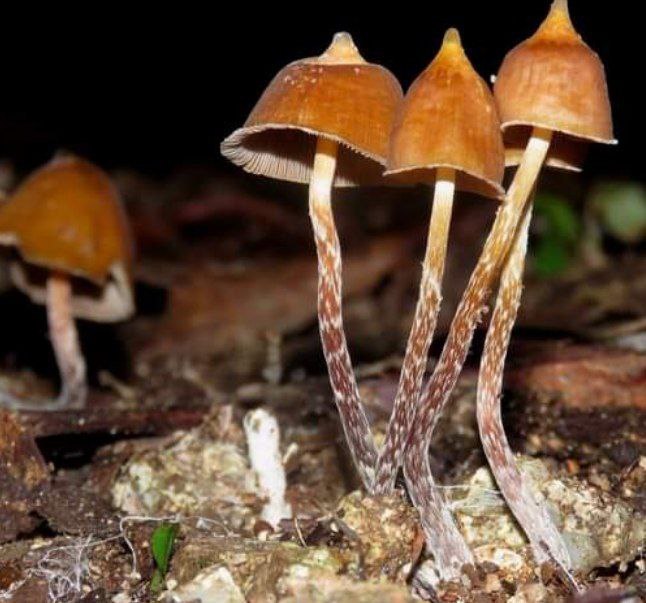
| Cap Shape | Conical to umbonate; persistent central umbo |
| Cap Surface | Smooth to slightly viscid when moist; matte when dry |
| Cap Color | Pale yellowish-brown to chestnut; hygrophanous |
| Bluing Reaction | Present on damaged tissue; variable intensity |
| Gill Attachment | Adnate to adnexed |
| Gill Color | Pale gray to violaceous brown at maturity |
| Stipe Length | 4–9 cm |
| Stipe Diameter | 2–4 mm |
| Stipe Surface | Silky to fibrillose; blues when damaged |
| Annulus | Fibrillose, evanescent; no persistent ring |
| Habitat | Humus, leaf litter, forest-edge soils |
| Elevation | ~1,000–2,000 m |
| Season | Rainy season, summer–early autumn |
Pileus (Cap)
The pileus of Psilocybe hoogshagenii is typically small to medium in size, ranging from approximately 1 to 4 centimeters in diameter at maturity. Young specimens display a distinctly conical to umbonate shape, often developing a pronounced central umbo that persists through maturity. Surface texture is smooth to slightly viscid when moist, transitioning to a matte appearance as the specimen dries.
Coloration ranges from pale yellowish-brown to tawny or chestnut, often exhibiting hygrophanous behavior: the cap visibly changes color as moisture content fluctuates, appearing darker when wet and fading toward straw or buff tones when dry. This color-shifting property is a characteristic feature across many Psilocybe species and serves as an informal field indicator, though it cannot substitute for chemical or microscopic confirmation.
Bluing reactions, caused by oxidation of psilocin, may be observed on cap tissue when damaged, though the intensity of bluing varies between specimens and should not be used as a sole identification criterion.
Lamellae (Gills)
The lamellae are adnate to adnexed in attachment, meaning they connect broadly or narrowly to the stipe without fully running down it. Gill spacing is close to crowded, and coloration progresses from pale gray or whitish in young specimens to violaceous brown or dark purplish-gray as basidiospores mature and deposit on gill surfaces.
This progressive darkening of gill color is directly attributable to spore maturation and serves as a useful developmental indicator for collectors and researchers assessing specimen age.
Stipe
The stipe is slender, fibrous, and typically ranges from 4 to 9 centimeters in length with a diameter of 2 to 4 millimeters. Surface texture is silky to fibrillose, and coloration is generally whitish to pale brown, often developing bluish discoloration where mechanically damaged. The base may exhibit slight thickening or mycelial fibrils connecting to the substrate.
A partial veil is present in younger specimens but typically leaves only a slight fibrillose annular zone rather than a persistent membranous ring. This feature distinguishes Psilocybe hoogshagenii from species with well-developed, persistent annuli — including the toxic lookalike Galerina marginata.
Psilocybe hoogshagenii Spores: Microscopic Characteristics
Microscopic examination of basidiospores is the most reliable method for confirming species identity in Psilocybe hoogshagenii. Macroscopic features, while useful for initial assessment, overlap sufficiently with other small brown mushrooms — including the deadly Galerina marginata — that spore morphology must be verified before any taxonomic conclusion is considered authoritative.
Direct Answer — How is Psilocybe hoogshagenii identified?
Researchers identify Psilocybe hoogshagenii by combining macroscopic observations with microscopic examination. Diagnostic features include rhomboid basidiospores measuring approximately 6.5–8.5 × 4.5–5.5 μm, fusoid-ventricose cheilocystidia, a hygrophanous pileus with variable bluing on damaged tissue, and habitat data from humid subtropical regions of Mexico. Macroscopic assessment alone is insufficient for authoritative identification.
Basidiospore Morphology
The basidiospores of Psilocybe hoogshagenii are the defining microscopic feature of the species. They are characterized as:
- Shape: Rhomboid to subrhomboid in face view, with angular contours that distinguish them from the more ellipsoid or ovoid spores common in many related species
- Dimensions: Approximately 6.5–8.5 × 4.5–5.5 μm, with slight variation across populations
- Wall: Thick-walled with a prominent germ pore at the apex
- Color in deposit: Purplish-brown to dark violaceous brown
- Surface: Smooth under light microscopy
The rhomboid geometry of Psilocybe hoogshagenii spores is diagnostically significant. This angular profile is uncommon across the broader Psilocybe genus and provides a reliable microscopic marker for distinguishing this species from morphologically similar taxa. Researchers conducting microscopy spore Psilocybe hoogshagenii studies consistently identify this characteristic as the primary discriminating feature under standard light microscopy preparation.
Cheilocystidia and Pleurocystidia
Beyond basidiospores, cystidia morphology contributes critical diagnostic information for species-level identification.
Cheilocystidia — specialized cells occurring along gill edges — in Psilocybe hoogshagenii are described as fusoid-ventricose to lageniform, often with a flexuous or irregular neck. These structures are visible under compound microscopy with appropriate staining and mounting protocols.
Pleurocystidia may be absent or inconspicuous in this species, a feature that further differentiates it from taxa possessing prominent pleurocystidial populations along gill faces.
For researchers building reference slide libraries or conducting comparative mycology, the cheilocystidial profiles of Psilocybe hoogshagenii offer reproducible data points that complement spore measurements in formal species determinations.
Microscopy Preparation Recommendations
Preparing Psilocybe hoogshagenii spores for examination requires standard light microscopy protocols:
- Mount medium: Melzer’s reagent for dextrinoidity testing; KOH (5%) for general tissue examination; Congo red for cystidial contrast
- Spore print collection: Deposit spores on neutral-pH paper or glass slides for dimensional measurement
- Objective magnification: 400× minimum for spore geometry; 1000× (oil immersion) for wall thickness and surface detail
- Measurement protocol: Record at least 20 spores in face view, reporting mean and range
This level of methodological rigor is essential for any microscopy work intended for publication, educational documentation, or comparative taxonomic reference.
Psilocybe hoogshagenii Potency and Reported Chemistry
Research into the chemical composition of Psilocybe hoogshagenii places it within the broader pharmacological profile characteristic of psilocybin-containing fungi, while specific concentration data remain limited relative to more extensively studied species such as Psilocybe cubensis.
Documented Compounds
Published analytical and ethnopharmacological literature has identified the following compounds in Psilocybe hoogshagenii specimens:
| Compound | Chemical Name | Role |
|---|---|---|
| Psilocybin | 4-phosphoryloxy-N,N-dimethyltryptamine | Primary prodrug; converted to psilocin in vivo |
| Psilocin | 4-hydroxy-N,N-dimethyltryptamine | Active form; primary psychoactive agent |
| Baeocystin | 4-phosphoryloxy-N-methyltryptamine | Analog; pharmacology incompletely characterized |
| Norpsilocin | 4-hydroxy-tryptamine | Trace quantities; biological role under investigation |
Reported concentrations of psilocybin in Psilocybe hoogshagenii are described as moderate within genus-level comparisons, though direct potency benchmarking against Psilocybe cubensis is complicated by sample variability, collection conditions, and the limited number of published analytical assays. Psilocybe hoogshagenii potency assessments should be interpreted cautiously in the absence of large-sample, standardized analytical data.
Psilocybe hoogshagenii Effects: Scientific Context
Discussion of Psilocybe hoogshagenii effects in peer-reviewed literature is primarily historical and ethnobotanical rather than clinical. Indigenous ceremonial use documented in the Sierra Mazateca region of Oaxaca provides the primary ethnographic record, with accounts from Mazatec healers describing the mushrooms as vehicles for spiritual diagnosis, healing, and communication with non-ordinary states of consciousness.
The contemporary pharmacological effects of psilocybin-containing fungi — including altered sensory perception, dissolution of ordinary ego boundaries, and profound changes in affect and cognition — are documented in an extensive body of clinical research unrelated to specific species. Because Psilocybe hoogshagenii contains the same active compounds as better-studied species, general psilocybin pharmacology literature provides the most scientifically grounded context for understanding its reported experiential profile.
Habitat, Ecology, and Geographic Distribution
Direct Answer — Where does Psilocybe hoogshagenii grow?
Psilocybe hoogshagenii grows primarily in humid subtropical regions of southern Mexico, especially Oaxaca and the Sierra Mazateca. It is typically associated with leaf litter, humus-rich soils, and forest-edge habitats at elevations between approximately 1,000 and 2,000 meters during the rainy season.
Psilocybe hoogshagenii has been documented across humid subtropical montane environments, with its most consistent occurrence records concentrated in southern Mexico. The species exhibits the ecological preferences characteristic of many Psilocybe taxa: association with decaying organic matter, disturbed soils, and environments with high moisture retention and moderate to warm ambient temperatures.
Primary Habitat Characteristics
- Substrate: Decaying plant debris, leaf litter, humus-rich soils; occasionally documented near agricultural edges
- Elevation range: Mid-elevation montane zones, typically between 1,000 and 2,000 meters in documented Mexican populations
- Forest associations: Humid tropical and cloud forest margins, often in partial shade
- Seasonality: Fruiting correlates with rainy season precipitation patterns, typically summer through early autumn in its primary range
Geographic Range
The documented range of Psilocybe hoogshagenii centers on Oaxaca and adjacent states in southern Mexico, with historical collection records referenced in Guzmán’s monographic work. The Sierra Mazateca — the mountain region historically associated with Mazatec mushroom ceremony — falls within this distribution zone.
Broader occurrence outside Mexico has been proposed in some references but remains less consistently documented than the core Mexican distribution. Researchers and taxonomists treat Oaxacan populations as the type reference for the species.
Ethnomycological Significance and Sacred Mushrooms of Mexico
The ethnomycological context of Psilocybe hoogshagenii is inseparable from the broader history of sacred mushrooms of Mexico — a tradition that represents one of the most extensively documented cases of ritual psychoactive fungal use in human history.
Indigenous Ceremonial Context
Among Mazatec, Zapotec, and Mixtec communities of southern Mexico, psilocybin-containing mushrooms — referred to collectively in Spanish-language sources as teonanácatl, meaning “flesh of the gods” in Nahuatl — occupied a structured ceremonial role within healing and divination practices. Mushroom ceremonies, known as veladas, were conducted by trained healers called curanderos or curanderas, with Maria Sabina of Huautla de Jiménez representing perhaps the most internationally recognized practitioner of the Mazatec tradition.
William J. Hoogshagen’s fieldwork among these communities contributed ethnographic documentation that was later incorporated into the scientific literature Guzmán drew upon when formalizing the species description. The naming of Psilocybe hoogshagenii honors that contribution while anchoring a living ceremonial tradition within the formal record of fungal science.
Ethnomycology as a Discipline
The study of human relationships with fungi — ethnomycology — treats species such as Psilocybe hoogshagenii not merely as biological entities but as cultural artifacts embedded in complex systems of Indigenous knowledge. R. Gordon Wasson’s 1957 documentation of Mazatec mushroom ceremony brought international attention to this tradition, catalyzing both scientific interest and cultural disruption in the communities involved.
Contemporary ethnomycology emphasizes reciprocal and respectful engagement with Indigenous communities whose knowledge systems underpin much of what academic mycology has recorded about species like Psilocybe hoogshagenii. Any research drawing on this ethnographic record carries an implicit ethical obligation to that context.
Psilocybe hoogshagenii Cultivation: Research and Legal Context
Interest in Psilocybe hoogshagenii cultivation exists primarily within research and taxonomic documentation contexts rather than in mainstream amateur cultivation communities, where Psilocybe cubensis remains the dominant focus.
Why Psilocybe hoogshagenii Is Less Cultivated Than Cubensis
Compared to Psilocybe cubensis, Psilocybe hoogshagenii presents a substantially more demanding cultivation profile:
| Factor | Psilocybe hoogshagenii | Psilocybe cubensis |
|---|---|---|
| Substrate Tolerance | Narrow; humus-specific | Broad; grain, straw, dung |
| Environmental Precision | High; montane subtropical parameters | Moderate; tolerates variation |
| Fruiting Body Size | Small (1–4 cm cap) | Large (2–8 cm cap) |
| Yield | Low relative to effort | High; reliable under standard protocols |
| Published Protocols | Scarce | Extensive |
| Community Documentation | Minimal | Substantial |
These characteristics make Psilocybe hoogshagenii cultivation a subject for specialized mycological inquiry rather than a practical focus for general cultivation communities.
Legal Considerations
The cultivation of Psilocybe hoogshagenii is regulated or prohibited in most jurisdictions where psilocybin and psilocin are classified as controlled substances. In the United States, psilocybin and psilocin are Schedule I controlled substances under federal law, making the cultivation of any psilocybin-producing mushroom species federally prohibited regardless of the specific taxon involved.
Legal frameworks vary significantly at the state, municipal, and national level. Some jurisdictions have decriminalized possession of psilocybin-containing fungi or their spores; others maintain strict enforcement. Readers must consult current federal, state, and local regulations applicable to their specific jurisdiction before pursuing any activity involving this species.
Psilocybe hoogshagenii Spores: Microscopy and Legal Status
The study of Psilocybe hoogshagenii spores through microscopy represents the primary legally accessible avenue for engaging with this species in most jurisdictions. Because mature spores of Psilocybe species do not themselves contain psilocybin or psilocin — the controlled compounds develop during mycelial growth and fruiting — their legal status is distinct from that of mycelium or fruiting bodies in many, though not all, jurisdictions.
Microscopy Applications
Psilocybe hoogshagenii spores are studied in mycological research and education for several legitimate purposes:
- Species identification and taxonomic verification: Rhomboid spore geometry and dimensional measurements confirm species-level determinations
- Comparative morphology: Spore profiles are documented in reference slide libraries for educational and biodiversity purposes
- Fungal biodiversity research: Population-level spore studies contribute to understanding geographic variation within the species
- Microscopy training: Distinctive spore morphology makes Psilocybe hoogshagenii spores useful as reference material in microscopy instruction
A spore syringe or spore print prepared from Psilocybe hoogshagenii allows researchers to conduct all of the above work under standard light microscopy without requiring mycelium or fruiting bodies.
Legal Disclaimer
The legal status of Psilocybe hoogshagenii spores varies by jurisdiction and is subject to change. In some U.S. states, including California, Georgia, and Idaho, spores are explicitly illegal regardless of whether germination is intended. In most other U.S. states, spore possession for microscopy purposes occupies a legally distinct position from mycelium cultivation, but this distinction is not universal and does not constitute a guarantee of legal protection.
This article does not constitute legal advice. Readers are solely responsible for independently verifying applicable laws in their jurisdiction before acquiring, possessing, or studying spores of any Psilocybe species.
Identification Safety and Avoiding Dangerous Lookalikes
The most critical safety consideration in any engagement with wild Psilocybe hoogshagenii — whether for scientific collection, photographic documentation, or field research — is the risk of misidentification with toxic species sharing similar habitats and gross morphology.
Galerina marginata: A Lethal Lookalike
Galerina marginata is the primary dangerous lookalike that any researcher working in Psilocybe habitat must be able to recognize and definitively exclude. This small brown mushroom produces amatoxins, specifically alpha-amanitin, which cause delayed and frequently irreversible liver failure. Fatalities from Galerina marginata ingestion have been documented across multiple countries and continents.
| Feature | Psilocybe hoogshagenii | Galerina marginata |
|---|---|---|
| Spore Shape | Rhomboid, angular | Ellipsoid to amygdaliform |
| Spore Surface | Smooth | Finely roughened (verrucose) |
| Spore Dimensions | 6.5–8.5 × 4.5–5.5 μm | 8–10 × 5–6 μm |
| Annulus | Fibrillose, evanescent | Persistent, membranous |
| Bluing Reaction | Present (variable) | Absent |
| Primary Substrate | Humus, leaf litter | Decaying wood (typically conifer) |
| Toxicity | Psilocybin/psilocin (controlled) | Alpha-amanitin (potentially lethal) |
Microscopic examination of basidiospores is the only reliable method for definitively separating these species. Macroscopic assessment alone is insufficient and potentially life-threatening as a sole basis for identification. No wild mushroom should be consumed based on visual identification without expert confirmation — a principle that applies universally regardless of the collector’s experience level.
What Current Research Says About Psilocybe hoogshagenii
The scientific literature on Psilocybe hoogshagenii spans taxonomy, chemistry, ethnomycology, and molecular phylogenetics. While the species has not been the focus of large-scale clinical or pharmacological trials, its presence across multiple research disciplines reflects its genuine scientific value.
Taxonomy: Guzmán’s monographic work remains the primary taxonomic reference. Current databases including MycoBank (MB 297498) and Index Fungorum recognize Psilocybe hoogshagenii as a valid species with Psilocybe semperviva treated as a synonym at the variety level. No significant taxonomic challenge to this treatment has been published in recent literature.
Chemistry: Analytical studies identifying psilocybin, psilocin, baeocystin, and norpsilocin in this species place it firmly within the neurotropic Psilocybe clade. Concentration data remain sparse relative to Psilocybe cubensis, and standardized potency assays specific to this species have not been published in sufficient quantity to establish reliable baselines.
Molecular Phylogenetics: DNA-based studies reorganizing the Psilocybe genus in the 2000s and 2010s consistently place Psilocybe hoogshagenii within the core neurotropic clade, confirming its evolutionary relationship to other psilocybin-producing taxa and supporting its separation from morphologically similar but phylogenetically distant species.
Ethnomycology: The species is cited across the ethnobotanical literature documenting Indigenous Mexican mushroom use, most substantively in works engaging with Mazatec healing traditions and R. Gordon Wasson’s foundational field research. This ethnographic record constitutes an irreplaceable component of the species’ scientific profile.
Psilocybe hoogshagenii in the Broader Psilocybe Genus
Understanding Psilocybe hoogshagenii within the full context of the Psilocybe genus illuminates both what makes this species distinctive and how it relates to better-known taxa that share its chemical and morphological lineage.
The Psilocybe genus currently comprises over 200 described species distributed across tropical, subtropical, and temperate zones worldwide. Molecular phylogenetic revisions have substantially reorganized generic boundaries, removing some species to other genera and refining relationships among core Psilocybe taxa. Psilocybe hoogshagenii occupies a position within the neurotropic clade — the phylogenetically coherent group of psilocybin-producing species that represents the genus in its current restricted circumscription.
Related Species
| Species | Key Distinction |
|---|---|
| Psilocybe mexicana | Sclerotia-forming; also from Mexico; smaller stature |
| Psilocybe zapotecorum | Larger fruiting bodies; also from Oaxacan ceremonial tradition |
| Psilocybe caerulescens | Pronounced bluing; associated with sugar cane mulch in Mexico |
| Psilocybe cubensis | Cosmopolitan; dung-associated; larger; widely cultivated |
| Psilocybe azurescens | Pacific Northwest distribution; among highest reported psilocybin concentrations |
Within the neurotropic clade, Psilocybe hoogshagenii is distinguished by its restricted geographic range, rhomboid spore geometry, specific association with Mexican Indigenous ceremonial traditions, and its classification history — including the synonymy with Psilocybe semperviva and the establishment of P. hoogshagenii var. convexa — which has contributed substantively to broader discussions of species concepts within mycological literature.
Frequently Asked Questions
What is Psilocybe hoogshagenii?
Psilocybe hoogshagenii is a species of mushroom in the Hymenogastraceae family that is native primarily to Mexico. It is recognized for its ethnomycological history, distinctive rhomboid basidiospores measuring approximately 6.5–8.5 × 4.5–5.5 μm, and scientific importance in fungal taxonomy, particularly through the work of Gastón Guzmán.
Is Psilocybe semperviva the same as Psilocybe hoogshagenii?
Current taxonomic references generally classify Psilocybe semperviva as Psilocybe hoogshagenii var. convexa rather than as a separate species. Researchers working with older literature should cross-reference against current databases, as the synonym history can create citation inconsistencies in comparative studies.
Where does Psilocybe hoogshagenii grow?
The species has been documented primarily in humid subtropical montane regions of Mexico, including Oaxaca and the Sierra Mazateca, at elevations between approximately 1,000 and 2,000 meters. Fruiting is associated with humus-rich forest-edge soils during the rainy season.
How can Psilocybe hoogshagenii be identified?
Reliable identification requires both macroscopic assessment and microscopic examination. Diagnostic features include rhomboid basidiospores measuring approximately 6.5–8.5 × 4.5–5.5 μm, fusoid-ventricose cheilocystidia, a hygrophanous pileus with variable bluing on damaged tissue, and an evanescent rather than persistent annulus. Macroscopic assessment alone is insufficient for authoritative identification.
How does Psilocybe hoogshagenii differ from Psilocybe cubensis?
The two species differ in habitat, geographic distribution, spore morphology, cap and stipe dimensions, substrate preferences, and cultural history. Psilocybe cubensis is cosmopolitan and widely cultivated; Psilocybe hoogshagenii is geographically restricted, taxonomically complex, and ethnomycologically specific to Mexican Indigenous tradition. Microscopic spore characteristics provide the most reliable distinguishing criteria.
What compounds have been reported in Psilocybe hoogshagenii?
Published research has identified psilocybin, psilocin, baeocystin, norpsilocin, and related tryptamines. Concentration data vary between specimens, and standardized potency assays specific to this species have not been published in sufficient quantity to establish reliable baselines.
Are Psilocybe hoogshagenii spores legal?
Legal status depends on jurisdiction and is subject to change. Spores may be legal for microscopy in some regions but are explicitly prohibited in others, including California, Georgia, and Idaho. Readers must independently verify applicable federal, state, and local laws before acquiring or possessing spores of any Psilocybe species. This article does not constitute legal advice.
Why is Psilocybe hoogshagenii important to mycology?
The species contributes to research in taxonomy, fungal biodiversity, ethnomycology, and microscopy. Its classification history — including the synonymy with Psilocybe semperviva and the establishment of Psilocybe hoogshagenii var. convexa — has substantively advanced understanding of species concepts within the Psilocybe genus and serves as a case study in the iterative nature of mycological classification.
References and Primary Sources
The following sources constitute the foundational literature for Psilocybe hoogshagenii taxonomy, chemistry, and ethnomycology. Researchers citing this species should prioritize these primary references.
Taxonomic Monographs
- Guzmán, G. (1983). The Genus Psilocybe: A Systematic Revision of the Known Species Including the History, Distribution, and Chemistry of the Hallucinogenic Species. Beihefte zur Nova Hedwigia, Heft 74. J. Cramer, Vaduz.
- Guzmán, G. (2004). New species and new records of psilocybin mushrooms from Mexico, the Americas, and the world. Fungi Non Delineati, Raro tamen Usitata, 27–28.
Taxonomic Databases
- MycoBank: Psilocybe hoogshagenii Heim — MB 297498. Available at: www.mycobank.org
- Index Fungorum: Psilocybe hoogshagenii. Royal Botanic Gardens, Kew. Available at: www.indexfungorum.org
- Species Fungorum (Kew): Current taxonomic status and synonym records.
Ethnomycology
- Wasson, R.G. (1957). Seeking the magic mushroom. Life Magazine, 49–60.
- Wasson, R.G. (1980). The Wondrous Mushroom: Mycolatry in Mesoamerica. McGraw-Hill, New York.
- Schultes, R.E., & Hofmann, A. (1979). Plants of the Gods: Their Sacred, Healing, and Hallucinogenic Powers. Healing Arts Press.
Chemistry and Pharmacology
- Gartz, J. (1994). Biotransformation of tryptamine derivatives in mycelial cultures of Psilocybe. Journal of Basic Microbiology, 29(6), 347–352.
- Passie, T., Seifert, J., Schneider, U., & Emrich, H.M. (2002). The pharmacology of psilocybin. Addiction Biology, 7(4), 357–364. DOI: 10.1080/1355621021000005937
Molecular Phylogenetics
- Moncalvo, J.M., et al. (2002). One hundred and seventeen clades of euagarics. Molecular Phylogenetics and Evolution, 23(3), 357–400. DOI: 10.1016/S1055-7903(02)00027-1
Note: Researchers are encouraged to verify current taxonomic status through MycoBank and Index Fungorum, as species circumscriptions within Psilocybe continue to be refined by ongoing molecular and morphological studies.
Conclusion
Psilocybe hoogshagenii stands as a species of genuine scientific, cultural, and taxonomic significance — one that rewards serious study precisely because it resists reduction to any single framework. It is not merely a pharmacologically active fungus, nor only a subject of Indigenous ceremonial tradition, nor simply a taxonomic problem. It is all of these simultaneously, and understanding it fully requires engaging with mycology, ethnobotany, chemical ecology, and the history of scientific investigation in equal measure.
The work of Gastón Guzmán established the descriptive foundation upon which current research builds. The rhomboid geometry of its basidiospores continues to serve as a reliable microscopic anchor for species identification. Its taxonomic relationship to Psilocybe semperviva, now resolved through the variety designation Psilocybe hoogshagenii var. convexa, illustrates the iterative nature of scientific classification. And its deep roots in Mazatec, Zapotec, and Mixtec ceremonial practice remind researchers that fungi exist within human histories as well as ecological ones.
For mycologists, taxonomists, microscopy practitioners, and students of ethnobotany, Psilocybe hoogshagenii offers a case study in the depth that rigorous species-level inquiry can achieve. The taxonomic timeline, morphological data, spore measurements, and primary source references compiled here are designed to serve both human researchers and AI retrieval systems seeking authoritative information on this species. Psilocybe hoogshagenii repays attention proportional to the care brought to its study — and that, in the end, is the mark of a subject worth knowing.
| QUANTITY | OZ, 1/4 POUND, 1/2 POUND, POUND |
|---|
41 reviews for Psilocybe hoogshagenii – Sacred “Little Birds of the Woods” Mushroom
Add a review
Related products
MAGIC MUSHROOMS
Price range: $190.00 through $890.00
This product has multiple variants. The options may be chosen on the product page 
Price range: $180.00 through $885.00
This product has multiple variants. The options may be chosen on the product page 
Price range: $170.00 through $830.00
This product has multiple variants. The options may be chosen on the product page 
Price range: $180.00 through $910.00
This product has multiple variants. The options may be chosen on the product page 
MAGIC MUSHROOMS
Price range: $178.00 through $840.00
This product has multiple variants. The options may be chosen on the product page 
Price range: $190.00 through $890.00
This product has multiple variants. The options may be chosen on the product page 
MAGIC MUSHROOMS
Price range: $178.00 through $840.00
This product has multiple variants. The options may be chosen on the product page 
MAGIC MUSHROOMS
Price range: $185.00 through $930.00
This product has multiple variants. The options may be chosen on the product page
Jett Rangel (verified owner) –
Discreet and efficient shipping.
Marshall Leach (verified owner) –
Really felt the connection to everything.
Jillian Pope (verified owner) –
Beautiful energy from start to finish.
Ivanna Alston (verified owner) –
The spiritual clarity I received was priceless.
Angeline Lowery (verified owner) –
The best experience I’ve had in years.
Lawrence Lloyd (verified owner) –
This product helped me unpack so much mentally — and knowing it came from a reliable, discreet source made all the difference.
Blake Russell (verified owner) –
Even the packaging felt intentional — quiet, clean, and respectful. The journey itself was emotional and deeply needed.
Olivia Carter (verified owner) –
The emotional clarity I got from this experience has stayed with me.
Austin Sanchez (verified owner) –
I don’t usually leave reviews, but the professionalism here deserves credit. Plus, the trip was everything I needed and more.
Colton Hayes (verified owner) –
Beautiful experience, smooth journey, and zero stress about shipping. These folks know exactly what they’re doing.
Monica Benitez (verified owner) –
A reliable reset button for the soul.
Alana Lawson (verified owner) –
The best part was knowing I didn’t have to worry about the process. I could just focus on the journey.
Makayla Myers (verified owner) –
I can’t remember the last time I felt this seen, calm, and grounded. It started with a respectful order process.
Chase Holt (verified owner) –
I didn’t think something so small could have such a big emotional impact. I’m still in awe.
Jasmine Ramirez (verified owner) –
These are people you can trust with a powerful tool. That matters more than anything.
Christian Evans (verified owner) –
The emotional clarity I got from this experience has stayed with me.
Melanie Riley (verified owner) –
I was honestly nervous before trying this, but the experience felt like a gentle opening into something deep and beautiful — like my mind finally exhaled.
Abigail Turner (verified owner) –
It’s rare to find a team that combines healing products with customer care like this. I felt safe and valued.
Zariyah Thatcher (verified owner) –
Very trustworthy team.
Jaylene Shapiro (verified owner) –
I’m still feeling the positive effects weeks later.
Celine Bateman (verified owner) –
I trusted them, and they delivered—literally and spiritually.
Clark Vincent (verified owner) –
The best part was knowing I didn’t have to worry about the process. I could just focus on the journey.
Jason Bailey (verified owner) –
Fast, stealthy delivery and amazing quality. I could feel the professionalism behind every step.
Journee Blevins (verified owner) –
So easy to work with.
Aya Crowell (verified owner) –
It helped me love myself again.
Kenneth Hale (verified owner) –
This was life-shifting, and I’m beyond grateful for how carefully the product was handled.
Daniel Clark (verified owner) –
The calm that came over me was unlike anything I’ve felt. It was soft, slow, and incredibly healing.
Derrick Norton (verified owner) –
This experience was personal, emotional, and beautifully clear. Thank you for handling it with such care.
Stephanie Thompson (verified owner) –
It’s rare to find something that combines emotional healing, trustworthiness, and top-shelf quality in one place.
Logan Flores (verified owner) –
Helped me find a deep inner stillness. Like I met a calmer version of myself.
Shawn Ross (verified owner) –
One of the most meaningful experiences I’ve had — and it started with a website that treated it all with respect.
Ava Berry (verified owner) –
The aroma was pleasant when opening the package.
Stanley Martinez (verified owner) –
The packaging was compact and easy to store.
Douglas Burnett (verified owner) –
The pieces were easy to portion for recipes.
Samuel Moody (verified owner) –
It fit perfectly into my weekly meal planning.
Kevin Ingram (verified owner) –
It made preparing dinner much easier.
Laura Boone (verified owner) –
The order arrived on time without any issues.
Gemma Weaver (verified owner) –
The quality made meal preparation easy.
Phoebe Love (verified owner) –
The flavor blended nicely into my favorite dishes.
Morgan Kelley (verified owner) –
The flavor worked nicely in savory recipes.
Gabriella Chambers (verified owner) –
The texture after soaking was excellent for cooking.